
Invisalign and teeth straightening
Adult open bite: comparing aligners, fixed braces and combined care
An open-bite proposal should explain which tooth and jaw relationships it addresses and which limitations remain.
Talk to us about straightening your teeth
You might have a particular change in mind, or simply want to know what is possible. At a £30 consultation, we can talk through your goals and explain how the next steps are planned.
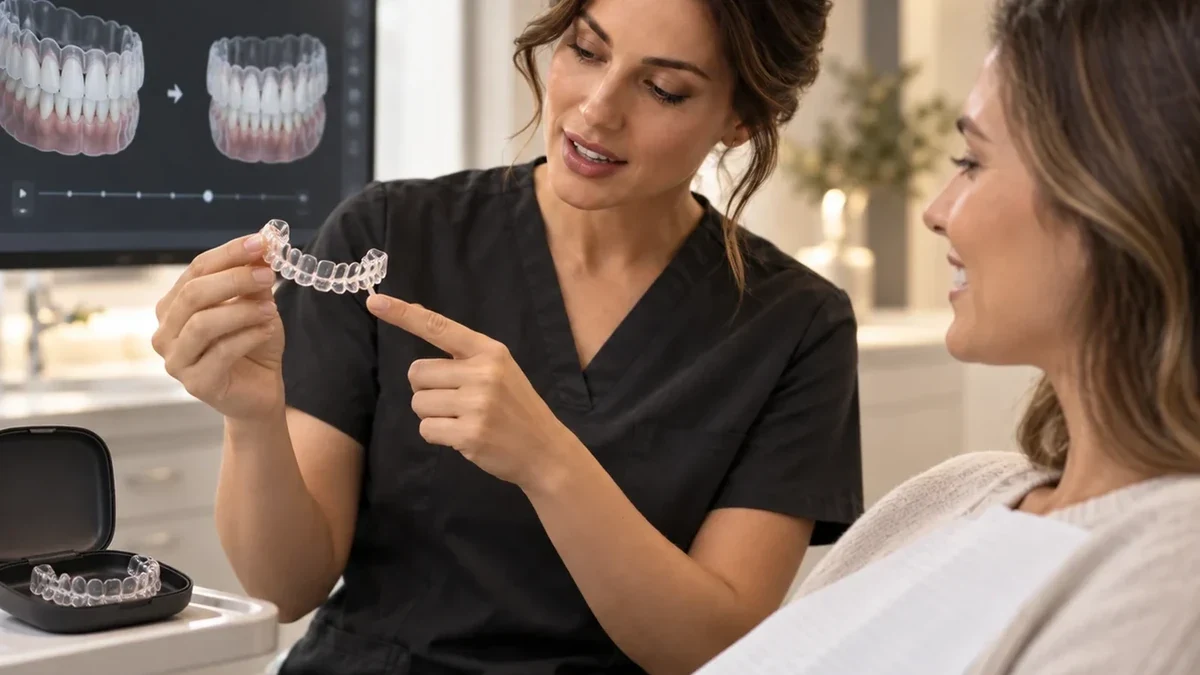
Compare the intended result, not only the appliance
Aligners or fixed braces may help an adult open bite, but suitability depends on the tooth positions, jaw relationship and amount of change needed. Some plans aim for fuller correction; others accept a defined compromise, and selected cases need combined care. Your clinician should explain the achievable goal before you compare appearance, treatment time or fees. [1][2]
Consider clear aligners within the available evidence
A 2025 systematic review found improvement in adult anterior open bite with aligners, with most included studies judged at moderate risk of bias. The findings support a possible treatment route in appropriate circumstances; they do not establish universal correction for every severity or jaw relationship. Ask what movements are intended and how progress will be assessed. Removability and appearance may be attractive, but the BOS emphasises the need for appropriate diagnosis and wear. An appliance should be selected because it supports the clinical plan, rather than because a digital image makes the end point look straightforward or guaranteed. [3][4]
Ask what fixed appliances or additional techniques would contribute
Fixed braces use brackets and wires to move teeth. If they are recommended, ask which part of the objective they help achieve and whether another suitable approach exists. BOS guidance notes that complex movements may require additional techniques, and a 2025 comparison of aligners and fixed appliances found that treatment context matters. A fair explanation should not claim that one appliance is always faster or superior in every situation. Cleaning, reviews, practical use and the intended movements belong in the decision alongside visibility. Understand what the alternative would change and which limitations would remain whichever appliance is chosen. [5][4][6]
Treat a surgical opinion as a separate decision
The BOS adult leaflet explains that selected adult problems may require combined jaw surgery and orthodontics. This does not mean every open bite needs surgery. If it is relevant, ask what the assessment would clarify, which change surgery is intended to achieve and what a non-surgical plan could reasonably provide instead. Consent for a proposed operation needs its own benefits, material risks and alternatives. Declining surgery should lead to a clear discussion of the remaining options and their limits, rather than either an unsupported promise of equivalent correction or a dismissal of the patient’s priorities. [2]
Discuss no active treatment and any separate care needs
You may decide against active correction after understanding the diagnosis and consequences. Ask what needs monitoring and whether any separate dental disease, symptoms or damage still requires treatment. A choice not to pursue an orthodontic goal is not the same as ignoring a health problem. Conversely, a visible gap does not by itself establish that every adult must accept the most extensive intervention available. The discussion should explain your actual findings and priorities. If treatment is deferred, agree a route for reassessment rather than assume the original proposal remains unchanged indefinitely.
Include retention and the complete practical commitment
All suitable active-treatment options need a discussion of retention and continuing review. NHS and BOS guidance describe retainers after orthodontics. Ask about the appliance routine, review arrangements, what happens if the response differs from the plan and the itemised estimate. At Iconic Smiles, confirm the responsible clinician and location. The best-supported decision is the one whose objective, compromise, treatment burden and care needs you understand. It should not rely on a promise that a discreet appliance eliminates every limitation or that a more extensive route guarantees a permanently perfect result without ongoing responsibility. [7][5][8][9][10]
For your treatment plan:
Be clear about the result each option aims to achieve. Appliance choice, a possible surgical assessment and any compromise in a non-surgical plan each need their own explanation.
Further clinical details: When your front teeth do not meet (open bite): treatment options
An open bite can be treated with orthodontics in suitable cases, while a substantial jaw discrepancy may need a discussion of combined orthodontic and surgical options. In an anterior open bite, the front teeth remain apart when the back teeth meet. This can affect biting through food, tooth display or some speech sounds. The first task is to establish how much comes from tooth position and how much from the jaws, because that guides what treatment can realistically achieve.
How the cause is investigated
The orthodontist checks front-tooth overlap, the contacts of the back teeth, incisor angles and the shape of both arches. Facial proportions and any relevant habits or functional factors also matter. Photographs and appropriate X-rays help distinguish a problem mainly involving the teeth and their supporting bone from one involving the jaw structure. A smile photograph or remote simulation cannot provide that assessment alone.
Different mechanical routes to closure
In selected cases, tooth movements that alter the vertical position or inclination of incisors can improve the open bite. Other plans depend on controlled movement of posterior teeth, sometimes with additional anchorage or auxiliary devices. Clear aligners and fixed appliances have different capabilities depending on the movements required. A practitioner should explain the specific planned mechanics rather than stating that a particular brand of plastic tray automatically closes every open bite.
When jaw relationships dominate
A significant skeletal discrepancy can limit what tooth movement alone can accomplish. Camouflaging the appearance of the bite may not address all functional concerns and can carry biological compromises. Some adults should be offered an opinion about combined orthodontic and orthognathic options where indicated. A surgical opinion is a discussion about diagnosis and choices, not a prediction that every open bite needs an operation.
The significance of tongue and function
Tongue posture, breathing and speech may need consideration where they are clinically relevant. An open bite should not automatically be blamed on one habit, and exercises alone cannot be promised to correct a structural bite problem. Appropriate input from other professionals may help manage an identified functional concern. The orthodontic plan still needs clear tooth-movement goals and a retention strategy.
Retention and relapse risk
Open-bite changes can be challenging to retain because vertical contacts depend on tooth position, skeletal relationships and ongoing functional influences. The team should explain how the final contacts will be checked and what retention is likely to involve. Patients should ask what degree of correction is realistic and how long-term review is organised. A technically closed bite at appliance removal is not the only measure of an enduring result.
Choosing the first consultation
Bring photographs of the smile you dislike and describe functional problems separately from cosmetic preferences. Ask whether the problem is dental or skeletal, which movements are required, what alternatives would achieve them and what the clinician considers the main relapse risks. The most credible plan will discuss uncertainty and stability openly, not show a flawless digital animation and treat it as a guarantee.
Distinguish cosmetic closure from a functional end-point
For example, someone may want the visible front gap closed but also have difficulty biting through food. The plan should consider both aims and whether closure would introduce unwanted pressure between teeth. Lengthening the front teeth with composite might disguise a gap without addressing the relationship between the arches. Controlled tooth movement may be feasible in a mild case mainly involving tooth position. A pronounced jaw discrepancy can limit such camouflage and may justify a surgical opinion. The discussion should explain those limits, any separate functional assessment and the uncertainty about long-term stability.
Research and guidance
- Why Orthodontics? - British Orthodontic Society (BOS)
- Primary professional guidance — bos.org.uk
- Efficacy of Clear Aligner Therapy for the Treatment of Anterior Open Bite in Adults: A Systematic Review and Meta-Analysis.
- Clear aligners - British Orthodontic Society (BOS)
- Braces — NHS
- Quality and stability of orthodontic treatment outcomes with clear aligners versus fixed appliances: a systematic review and meta-analysis.
- Retainers - British Orthodontic Society (BOS)
- Dental Team | Meet the Iconic Smiles Clinicians
- Dental Practices in Hertfordshire & London | Iconic Smiles
- Dental Fees & Finance: Treatment Prices | Iconic Smiles
Your next step, when you’re ready
We would be pleased to welcome you for a £30 consultation at your preferred Iconic Smiles practice. Bring your questions, and we can talk through the options that may suit you.
Any additional investigations and their fees will be explained before you decide.