
Invisalign and teeth straightening
Invisalign on the upper teeth only or lower teeth only: when is one arch enough?
Treating one arch can be appropriate when the change is limited and the finished bite will still function well. Even one visibly crooked tooth can involve other teeth to create safe movement
Talk to us about straightening your teeth
You might have a particular change in mind, or simply want to know what is possible. At a £30 consultation, we can talk through your goals and explain how the next steps are planned.
Please confirm the £30 planned-treatment consultation fee when booking. Scans, additional investigations and emergency assessments may have separate fees.
ICONIC SMILES · DIAMOND APEX
Invisalign care. Diamond Apex experience.
Choose Iconic Smiles, a Diamond Apex Invisalign provider serving Hertfordshire and North London, for individually planned clear aligner treatment.
What does Diamond Apex Invisalign Provider mean?
Diamond Apex is an Invisalign provider tier recognising high annual treatment volume. It reflects extensive experience with the Invisalign system. Your treatment is planned around your teeth, bite and goals, with clinical reviews and retention discussed from the outset.
The short answer: Treating one arch can be appropriate when the change is limited and the finished bite will still function well. Even one visibly crooked tooth can involve other teeth to create safe movement.
You might feel that your lower teeth are perfectly fine and that it is only the upper front teeth you want to straighten. Or perhaps the opposite is true: your upper smile looks even, but the lower incisors have become crowded over the years. If there is just one arch that bothers you, paying to treat both can seem unnecessary.
One-arch Invisalign can be an appropriate choice in selected cases. The important qualification is that upper and lower teeth do not function separately. They meet whenever you bite, chew or swallow, and moving one set can change those contacts. Before deciding which teeth need aligners, your clinician needs to look at the whole bite.
What does one-arch Invisalign actually involve?
Invisalign uses a sequence of clear, removable aligners planned to move teeth gradually. In a one-arch approach, the intended active movement is primarily in either the upper or lower arch, rather than both. The extent of that movement could be limited to a small cosmetic adjustment or involve several teeth, depending on the treatment plan.
It is important not to confuse one-arch treatment with short-course treatment. A limited plan describes the objectives and the degree of correction being attempted; one-arch describes where active movement is planned. You might need more movement in a single arch than the appearance of one crooked tooth suggests. Equally, an otherwise small change could still require movement in both arches to maintain a satisfactory bite.
Some plans may use appliances or retention measures involving both arches even when the main movement is in one. Ask what your particular plan entails rather than relying on the package name.
When might the upper teeth be treated alone?
Imagine that your lower teeth meet comfortably, their positions are stable and the main concern is a modest rotation or gap between upper incisors. If there is sufficient space, healthy gum and bone support, and the change can be made without creating awkward bite contacts, treating the upper arch alone may be reasonable.
Another example is a person whose upper teeth have moved slightly since previous orthodontic treatment while the lower alignment remains satisfactory. That might be a comparatively contained correction. However, previous treatment does not make the decision automatic. The clinician still needs to consider what caused the movement and how the result will be held with retainers.
A one-arch plan becomes less straightforward if the upper and lower front teeth already meet edge-to-edge, there is a deep bite, or the proposed movement would affect chewing contacts. These are reasons to assess the case carefully, not reasons to assume treatment is impossible.
What about straightening only the lower teeth?
Crowding of the lower front teeth is a common reason adults consider orthodontics. A few overlapping incisors can make the teeth look uneven even if the upper smile is one you like. Sometimes relatively modest lower-tooth movement is feasible without a wider treatment plan.
But lower teeth have to fit beneath the upper teeth. Making them line up beautifully from the front could change where they contact the upper incisors. If the upper teeth are already very close to the lower ones, there may not be room for the planned movement without addressing the other arch or creating carefully measured space.
Your dentist may therefore recommend treating both arches, or may explain that a deliberately limited lower-arch result is possible. Neither should be presented as a rule that applies to everyone.
The bite is not an obscure technicality
The term 'bite' simply describes how your teeth meet when you close together and how they move against one another during chewing. Some people have visible crowding but an otherwise stable, comfortable bite. Others have front-tooth contacts that are already placing pressure on particular teeth.
A clinician may examine how much the upper incisors overlap the lower ones, whether teeth meet in crossbite, where the back teeth make contact and whether there is evidence of wear or gum recession. They also consider whether the proposed movement will change the available space for restorative work.
This is not an argument that everyone needs perfect textbook alignment. Patients can choose more limited goals when clinically appropriate. The point is to understand the possible effects before accepting a plan that sounds simple because it treats only one row of teeth.
Will the lower teeth need to match the upper teeth?
Matching does not mean making both arches look identical. Upper and lower incisors have different shapes and proportions. What matters is whether the result looks harmonious when you speak and smile, and whether the teeth can meet appropriately.
If your upper teeth are being straightened to make room for bonding or a veneer, the lower front teeth may influence how long the new restoration can be and whether it will be placed under excessive force. In this situation the decision about one-arch orthodontics may need to involve the dentist planning the future restorative work.
If you are planning whitening, remember that tooth colour and tooth position are different decisions. It may be possible to whiten both arches even where aligner movement is limited to one.
Can one-arch Invisalign save money?
It may, but a lower fee is not guaranteed. The price depends on the assessed complexity, the type of Invisalign plan, records, clinical supervision, appliances, possible refinements and retainers. Treating fewer teeth does not necessarily halve the work or the number of appointments.
Iconic Smiles advertises Invisalign from £2,400. That is a group-wide starting price, not a specific promise for one-arch treatment. Before you commit, ask whether the quotation covers all relevant records, attachments, reviews, additional aligners if needed and the retention stage.
A useful way to compare two plans is to ask each clinician to show you exactly which teeth will move and why. A cheaper one-arch plan that cannot achieve your agreed objective is not a better-value version of a two-arch plan; it is a different treatment.
What will a digital preview show?
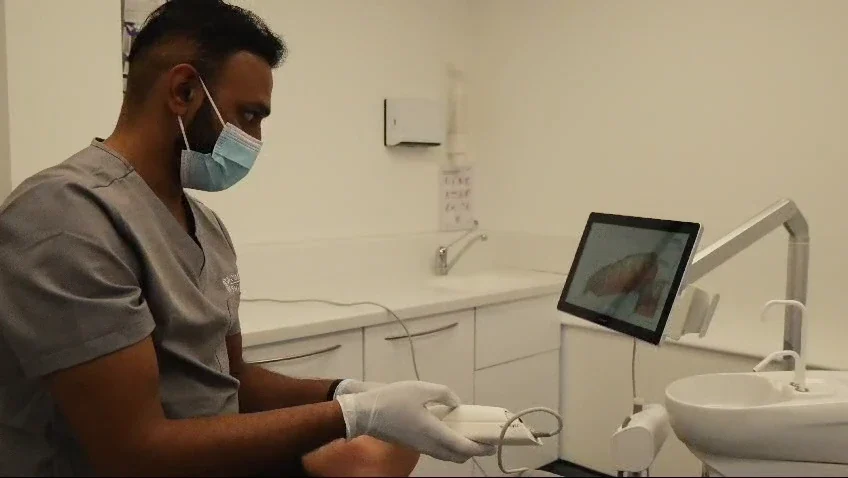
Digital planning can be excellent for helping you understand the proposed movements, but the appealing front-view simulation is only part of the picture. Ask to see how the upper and lower teeth meet at the end of the plan. Have the lower incisors gained enough clearance? Has the relationship between the canines changed? What will happen when you bite on the back teeth?
The simulation is a planning tool, not a guarantee that living teeth will move precisely as displayed. Your clinician should explain which movements are more predictable, how progress will be monitored and whether further aligners could be needed.
If a plan promises to finish on a fixed date regardless of how the teeth respond, it is worth asking how biological variation has been accounted for.
Are attachments or enamel reduction still needed?
They may be. Tooth-coloured attachments can help aligners apply forces more effectively to certain teeth. Small amounts of interproximal enamel reduction may sometimes be considered to make space between crowded teeth. Both need clinical justification and explanation.
Treatment involving only one arch does not remove the usual need to check dental health, root position, gum support and the way the teeth are expected to move. In people with thin gums or previously reduced bone support, the movement limits deserve particular care.
And afterwards — one retainer or two?
Retention should be planned before treatment begins. You may need a retainer for the treated arch and, depending on your clinical situation, retention or monitoring of the other arch. Teeth can shift over time even if they have not recently had active orthodontic treatment.
Ask which retainers are supplied, how to wear them and what to do if they no longer fit. Long-term maintenance is part of the decision, not a surprise at the finishing appointment.
The conversation worth having
If only your upper or lower teeth bother you, tell your clinician exactly that. You are not asking an unreasonable question. Ask them to assess whether your objective can be met while preserving a functional bite, what would be left unchanged and whether treating both arches would produce a materially different result.
A £30 planned-treatment consultation at Iconic Smiles offers a starting point to discuss suitability, with any additional records or tests explained separately. The best recommendation may be one-arch treatment, two-arch treatment or no orthodontics at all — and you should understand why.
Questions patients often ask
Will straightening only my upper teeth ruin my bite? Not necessarily. A carefully assessed one-arch plan can be suitable. It becomes risky when the opposing teeth have not been considered.
Can I have Invisalign on just six front teeth? A limited objective may focus on the front teeth, but other teeth may need to be involved in the movement or anchorage. The plan should show what is actually proposed.
Is lower-only Invisalign quicker? Not always. Duration depends on the movement, available space and biological response, not simply the arch chosen.
What if my teeth are already fairly straight? If the concern is small, it is entirely reasonable to discuss whether treatment offers enough benefit to justify the time, cost and retention commitment.
Find out whether one arch would really be enough
A smile photograph helps explain what bothers you, but your bite determines which movements are sensible. See how Invisalign is planned and start a smile enquiry if you would like your own case assessed.
Independent patient information: British Orthodontic Society: adult aligner and limited treatment decisions · NHS: orthodontics and bite assessment. These explain general clinical considerations; a personal recommendation requires assessment.
Your next step, when you’re ready
We would be pleased to welcome you for a £30 consultation at your preferred Iconic Smiles practice. Bring your questions, and we can talk through the options that may suit you.
Please confirm the £30 planned-treatment consultation fee when booking. Scans, additional investigations and emergency assessments may have separate fees.