
Healthy teeth and gums
Can Advanced gum disease Be Treated Without Losing Your Teeth?
Advanced periodontitis does not automatically mean all affected teeth must be removed.
Ask us about your teeth and gums
You can talk to our team about your concerns and what you would like to improve. A £30 planned-treatment consultation is a simple way to start exploring your options.
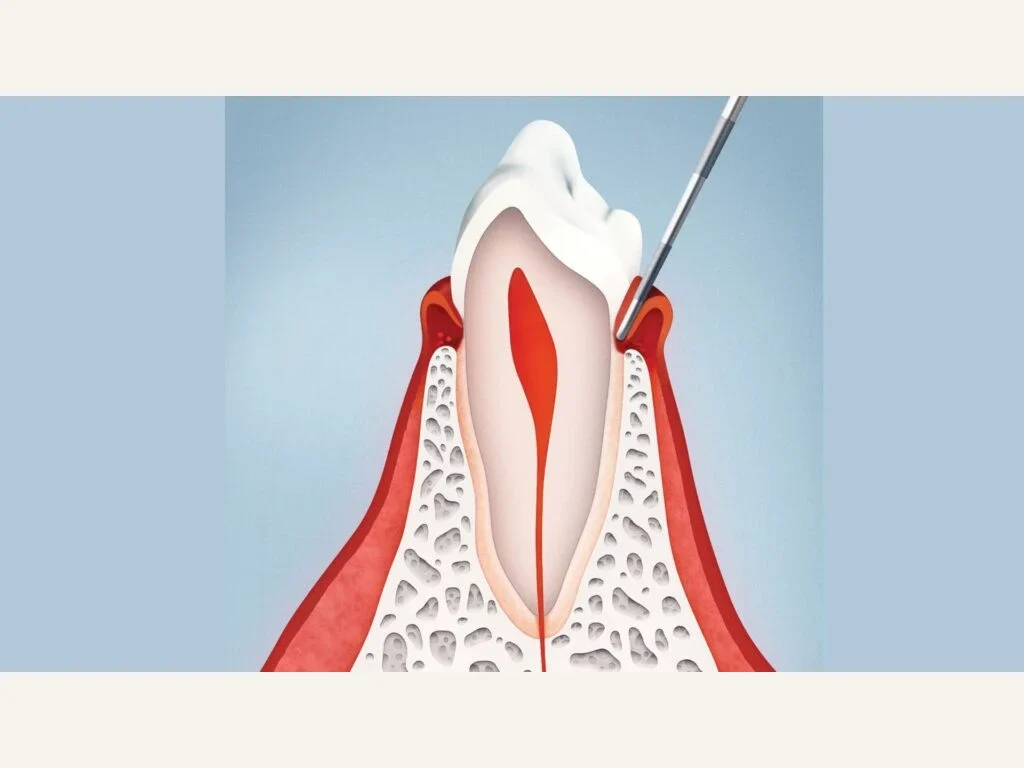
Advanced periodontitis does not automatically mean all affected teeth must be removed. Whether a tooth can be retained depends on its remaining support, mobility, function, disease pattern, restorability and the response to treatment. A structured gum health assessment should precede irreversible decisions wherever feasible.
What makes disease advanced
Advanced disease may include deep pockets, extensive attachment or bone loss, tooth migration, mobility, bite changes or complex defects. The condition is not diagnosed by the amount of visible recession alone. Full periodontal charting, relevant radiographs and an assessment of risk factors allow a tooth-by-tooth prognosis and identify urgent sources of infection.
The stabilisation phase
Initial treatment usually helps you improve plaque control, removes deposits and addresses changeable risks such as smoking or blood-glucose control. As inflammation settles, the clinician can reassess stability. Less swelling is useful, but does not prove that every deep site is controlled or lost support has regenerated.
Treatment beyond initial cleaning
Selected persistent defects may warrant further instrumentation, surgery or regenerative treatment when anatomy and patient factors support it. Moving teeth or planning large restorations before periodontal control can compromise the overall result. In complex cases, periodontal, restorative and orthodontic decisions must be coordinated instead of proceeding independently.
When a tooth has poor prognosis
Severe movement, a difficult fracture, disease between a molar's roots, structural damage or persistent inflammation may make a tooth less predictable to retain. The question is whether it can function and be kept clean at an acceptable risk. Sometimes extracting a poorly maintainable tooth can make it easier to care for the remaining teeth.
Avoid assuming implants solve periodontal susceptibility
Implants require healthy tissues and meticulous ongoing cleaning, and a history of periodontitis increases concern about peri-implant disease. Removing natural teeth does not remove the factors that contributed to the original problem. Replacement planning should take into account bone volume, existing support, maintenance ability and the complete treatment burden.
What a comprehensive proposal includes
A comprehensive proposal should record the starting measurements and risks, the treatment stages and when the response will be reassessed. Each tooth needs an explanation of its outlook. Compare costs and time with reasonable alternatives, including stabilisation, limited restoration or replacement where needed, and understand which findings could change the plan.
Advanced disease does not mean every affected tooth must be extracted
Periodontitis damages the tissues supporting teeth, but prognosis is assessed tooth by tooth and patient by patient. The clinician considers the pattern of attachment loss, pocket depths, bleeding, mobility, bone support, smoking or diabetes-related risks and the feasibility of cleaning the area. Some teeth can be retained after staged gum disease treatment and continued supportive care. Others may have poor prognosis because of severe destruction, root anatomy, fracture or inability to maintain stability.
Current periodontal guidance describes a stepwise approach that includes control of risk factors, oral-hygiene instruction, subgingival instrumentation where indicated, reassessment and long-term maintenance. Surgery or referral may be appropriate for selected persistent problems, but neither antibiotics nor a one-off 'deep clean' can substitute for sustained plaque control and review. Tooth extraction should be based on a defensible prognosis rather than the assumption that an implant is always a superior substitute.
Ask for an explanation of which teeth are considered maintainable, what response to treatment will be measured and what rehabilitation options exist if some teeth cannot be saved. A realistic plan can combine retention of stable natural teeth with replacement only where required.
Reassess prognosis after initial periodontal therapy
The first periodontal chart is not always the final prediction for every tooth. After appropriate plaque control, risk-factor management and subgingival instrumentation, clinicians can reassess pocket depths, bleeding and the patient's ability to clean. A tooth that remains mobile may still be maintainable in selected circumstances, but progressive support loss, a root fracture or persistent deep disease can change the recommendation.
A decision to extract should consider whether the tooth can function reliably, not simply whether it has a large pocket. Replacing a tooth with an implant does not eliminate susceptibility to plaque-associated inflammation, particularly for someone with past periodontitis. A maintenance programme and clear hygiene access remain essential whichever option is chosen.
Sources and professional guidance
- SDCEP, periodontal care, 2024
- SDCEP — prevention and treatment of periodontal diseases in primary care
- NICE CG19 — dental review intervals and personalised risk
Applying the information:
Treatment options · Our practices · Fees and finance
Furcation Involvement: Why Back-Tooth Cleaning Becomes Harder
A furcation is the area where a molar's roots divide. Bone loss can expose it and change the tooth's outlook, even when the visible crown looks intact.
Alternatives and clinical trade-offs
Assessment may include X-rays, access for probing and cleaning, and tooth mobility. Options can range from tailored cleaning advice and treatment below the gum to specialist periodontal care, selected surgery or extraction when the tooth cannot be maintained. Surgery for recession or restorative work may be relevant in selected sites after disease stability is established. Reassessment determines which further steps offer benefit.
Root anatomy can obstruct a straight route into the furcation, making it harder to clean than a single-rooted tooth with a similar pocket depth. Supportive care needs to suit that access. Mobility, root length and the tooth's possible role in a future bridge also affect planning.
Further reading (background sources)
- European Federation of Periodontology: treatment guideline — background reading
- — background reading
- NHS: dental treatment information — background reading
Your next step
Areas we serve: Hertfordshire · Bedfordshire · Buckinghamshire · Essex. Our actual clinics are in Hatfield, Cheshunt and Friern Barnet; Bedfordshire, Buckinghamshire and Essex are patient catchment areas, not additional clinic sites.
Your next step, when you’re ready
We would be pleased to welcome you for a £30 consultation at your preferred Iconic Smiles practice. Bring your questions, and we can talk through the options that may suit you.
Any additional investigations and their fees will be explained before you decide.