
Dental implants — replacing missing teeth
Lower-Jaw Implants: Nerve Safety and Scans
Replacing a missing lower premolar or molar involves planning close to important anatomical structures, including the inferior alveolar nerve canal and the mental foramen.
Explore your tooth replacement options
If you are considering replacing a tooth or several teeth, a £30 consultation gives you a chance to explain what matters most, ask questions and explore the options with our team.
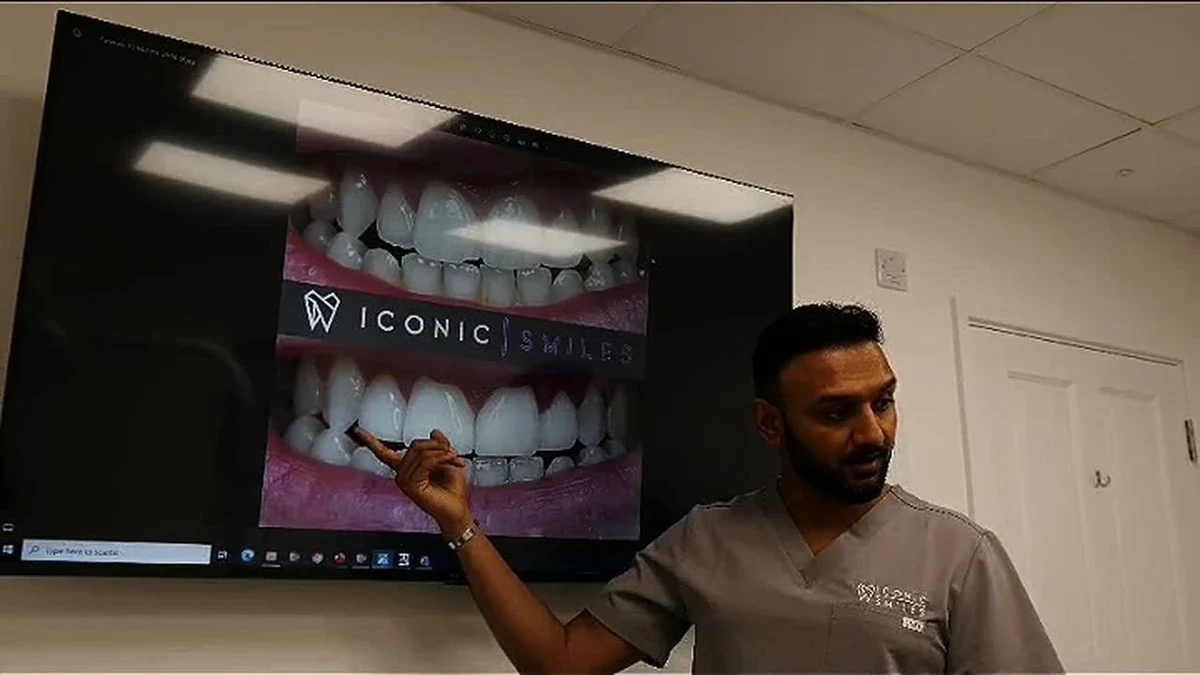
Lower-jaw implants need careful planning around nerves that supply sensation to parts of the lip, chin and teeth. For a premolar or molar, the nerve canal and its opening, the mental foramen, can limit implant length, angle or suitability. The proposed crown and implant need to be assessed together against this anatomy. Scans and planning can inform precautions, but cannot make surgery free of nerve risk.
Why a standard photograph is insufficient
The gum surface cannot show the distance to the nerve canal or the surrounding bone thickness. Examination and suitable X-rays provide information, with a three-dimensional CBCT scan justified where it would materially affect the surgical plan. The reason for the scan should be explained. Measurements still need clinical interpretation because anatomy, image quality and the operation introduce uncertainty.
The implant needs a tooth-led position
A fixture placed merely to avoid the nerve may emerge too far towards the tongue or at an unfavourable angle for the crown. The restorative dentist should define the intended chewing surface and cleanable contacts, then determine whether that design fits inside the available anatomical boundaries. A shorter or different-sized implant might be appropriate in some cases, but mechanical loading and the extent of remaining bone must be considered rather than treating small dimensions as universally safer.
What risks are discussed before consent
Altered sensation can be temporary or persistent after injury to nerve-related structures. The clinician should describe the nature of the relevant risk, the precautions being taken and the symptoms that warrant prompt postoperative review. Implant surgery is elective in many tooth-replacement cases, so the patient should have a meaningful comparison with alternatives. A written consent process should not imply that digital navigation eliminates all possibility of unexpected anatomical or surgical events.
Comparing a bridge with implant surgery
A bridge can sometimes restore a lower missing tooth without surgery near the nerve. A conventional bridge generally involves preparing neighbouring teeth, while a resin-bonded design is not appropriate for every load-bearing posterior situation. Leaving a particular gap may also be acceptable when the bite and patient priorities make replacement unnecessary. The choice balances the health of adjacent teeth, crown mechanics, anatomy and expected long-term care.
The practical question to ask
Request an explanation of where the intended crown will sit, what anatomical limit constrains the implant and what changes if sufficient safe space cannot be achieved. The best use of sophisticated imaging is to make that choice clearer, not to persuade the patient that a complicated operation is automatically better than a simpler restorative solution.
An illustrative molar near the mandibular canal
For example, a long-standing lower first-molar gap may have reduced bone height above the nerve canal. After defining the intended tooth position, the clinician uses justified imaging to assess the canal's course and surrounding bone. A shorter implant, a different replacement design or a non-surgical option may be appropriate. The assessment must relate the available anatomy to the final crown, rather than use the widest part of the ridge alone.
If avoiding the canal would put the crown too far towards the tongue, the resulting contour could trap food or obstruct cleaning. A bridge on suitable teeth may be worth comparing, with separate risks to its supports. Before surgery, understand the possible changes in sensation, how they would be monitored and which symptoms need urgent review. The team should explain the measurements and the alternative if a suitable implant path is unavailable. Careful imaging may therefore support a decision not to place an implant.
Your next step, when you’re ready
We would be pleased to welcome you for a £30 consultation at your preferred Iconic Smiles practice. Bring your questions, and we can talk through the options that may suit you.
Any additional investigations and their fees will be explained before you decide.