
Dental implants — replacing missing teeth
Narrow Dental Implants: Where They Work and Their Limits
A narrow gap does not necessarily require the same implant diameter as a missing molar.
Explore your tooth replacement options
If you are considering replacing a tooth or several teeth, a £30 consultation gives you a chance to explain what matters most, ask questions and explore the options with our team.
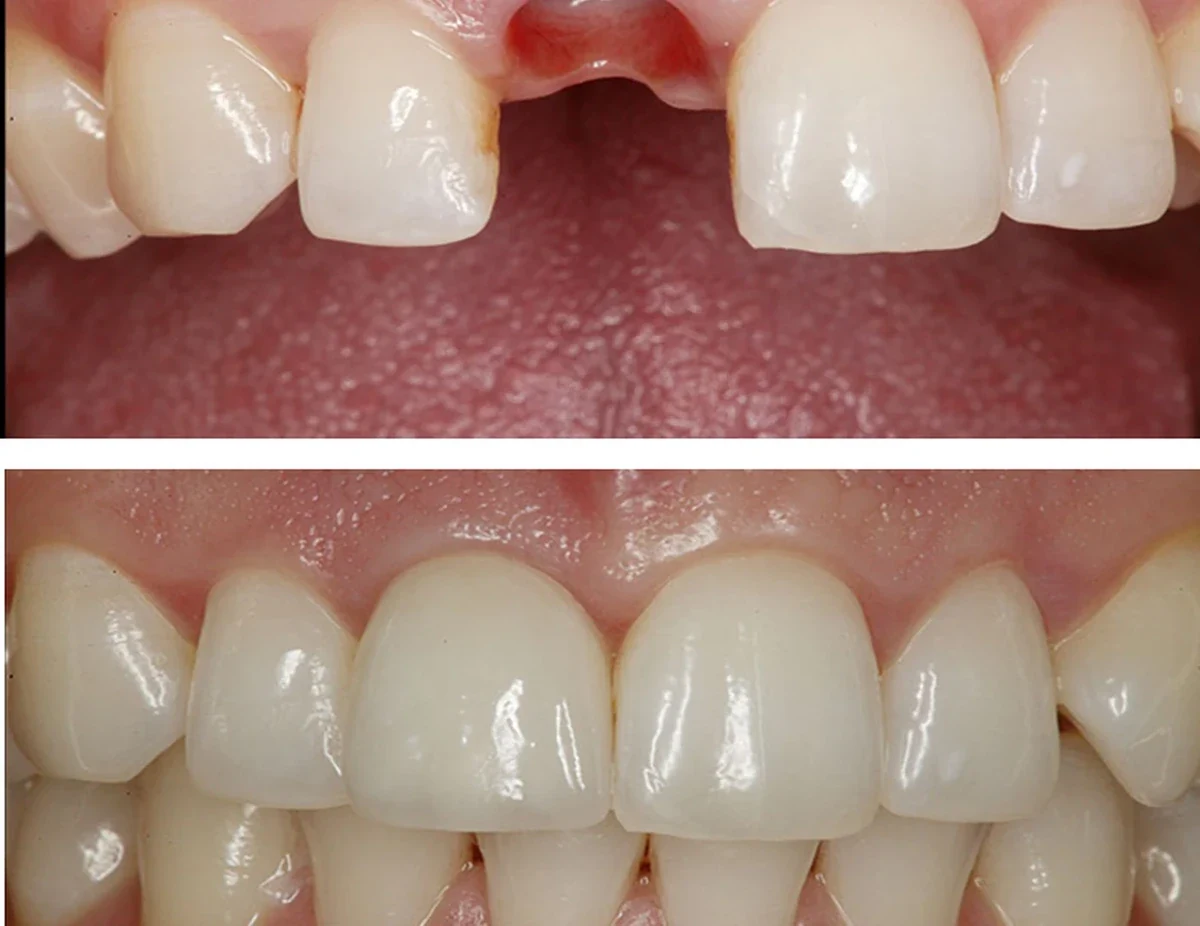
Narrow implants may suit selected gaps, particularly where the space between adjacent roots is limited. Implant widths vary because different teeth and sites have different demands. The smallest fixture is appropriate only if it can support a suitable crown within healthy tissue and the bite; the visible gap alone cannot decide its size.
Three spaces must fit at the same time
The visible gap between adjacent crowns is only the first measurement. Beneath the gum, the roots of neighbouring teeth may converge, leaving less room for an implant than the smile photograph suggests. Around the planned fixture there must also be sufficient bone to support long-term tissue health. Finally, the replacement crown needs enough width for natural proportions and healthy contact points without overhanging surfaces that trap plaque. A digital scan can show crown geometry, while appropriate radiographic assessment reveals roots and bone; together they explain why some apparently easy single-tooth spaces are more complicated.
Diameter and loading are linked
A narrower fixture has different dimensions and restorative connections, which affect how it behaves under load. A lower incisor and an upper molar face different forces, as do a single crown and a multi-tooth bridge. Research supports selected uses of narrow implants, while reviews continue to assess complications across diameters. The assessment therefore needs the planned restoration and bite as well as the space measurement.
When orthodontics may create a better site
If the crowns look widely spaced but their roots lean towards each other, gentle orthodontic movement may be considered before implant placement. The intention is not to make the smile look straighter for its own sake; it is to establish safer root separation and allow a restorative position that is more maintainable. An implant itself does not move under orthodontic forces like a natural tooth. Consequently, the order of treatment matters. For a young patient whose facial growth is still continuing, timing may be another reason to delay definitive implant placement while the space is managed appropriately.
A narrow ridge is a different problem
Sometimes there is adequate horizontal distance between neighbouring teeth but insufficient bone thickness from cheek to tongue. A narrow implant may avoid some augmentation in carefully selected anatomy; in other cases, bone grafting is more appropriate because the desired fixture needs support in a different position. Thin soft tissues also influence how a metal implant and crown will look through the gum, especially in the visible smile. An apparently less invasive choice should be compared against its effect on the gumline, crown emergence and long-term cleaning access.
The final crown drives the decision
Before placement, agree the crown's contacts, chewing surface and how it will be attached and accessed. A narrow implant that integrates in a compromised position can still make a satisfactory crown difficult to provide. A resin-bonded bridge may avoid surgery in a suitable case, with its own bonding and maintenance needs. Adjacent teeth, age, preference and the whole design help determine the choice.
Questions worth taking to your consultation
The consultation should show whether roots or ridge thickness limit implant size and how the proposed crown would look from the front and biting surface. If the narrowest fixture is unsuitable, understand the alternative and its trade-offs. The aim is a well-supported, maintainable tooth in an appropriate position.
Evidence and further reading
Making sense of the proposed size
A smaller diameter needs a reason linked to the roots, bone and crown. Seeing those parts together helps you judge the proposed implant against the alternatives.
Iconic Smiles practices are in Hatfield and Cheshunt in Hertfordshire, and Friern Barnet in North London. If travelling from Bedfordshire, Buckinghamshire or Essex, confirm the actual practice for each appointment.
Your next step, when you’re ready
We would be pleased to welcome you for a £30 consultation at your preferred Iconic Smiles practice. Bring your questions, and we can talk through the options that may suit you.
Any additional investigations and their fees will be explained before you decide.