
Invisalign and teeth straightening
A slanted smile line: can orthodontics make it more level?
Explore why a smile line can look tilted, how dentists distinguish tooth position from facial asymmetry and what orthodontic planning may involve.
Talk to us about straightening your teeth
You might have a particular change in mind, or simply want to know what is possible. At a £30 consultation, we can talk through your goals and explain how the next steps are planned.
£30 for a planned-treatment consultation. Scans, additional investigations and emergency assessments may have separate fees; please confirm when booking.
Perhaps you have noticed that one side of your smile sits slightly higher than the other. It may appear in photographs, or you may see it when you talk and laugh. People sometimes describe this as a 'slanted' or 'crooked' smile even when the individual teeth are quite straight. The first question is whether the teeth are sitting at an angle, the lips move differently on each side, or the face itself is naturally asymmetric.
Those possibilities are not interchangeable. Invisalign or braces may improve a tooth-related slant in selected cases. They cannot promise to make every person's face or smile perfectly level. And mild asymmetry is extremely common: a completely mirrored human face is not the standard against which you need to measure yourself.
If the imbalance bothers you, a thoughtful assessment can identify what is contributing to it and whether treatment would achieve a change you actually notice and value.
What does 'slanted smile' mean to a dentist?
Clinicians may describe a tilted line of teeth as an occlusal cant. Imagine drawing a line through the biting edges of your upper front teeth or across the level of the upper back teeth. If that line slopes relative to facial reference points, the smile may look uneven.
But your impression of a slant may come from elsewhere. One upper canine may sit higher than its partner. A single tooth may be shorter. The corners of your lips may lift unequally. A slightly crooked photograph, uneven posture or head tilt can exaggerate these effects.
For this reason, the clinician should observe your smile with your head in a natural position and compare tooth lines with facial features. A still photograph taken at an angle is not enough to diagnose a cant. It is useful to understand what is tilted before deciding what should move.
A 2026 systematic review of occlusal cant in people with more significant skeletal discrepancies emphasises the importance of distinguishing dental and skeletal asymmetry. [1] Its findings should not be used to imply that minor cosmetic unevenness requires the same investigations or treatment as severe jaw asymmetry.
When is it mainly the teeth?
Some slanted-looking smiles result from differences in tooth position. One side of the upper dental arch may sit lower, or certain teeth may have erupted differently. Tooth wear, previous restorations and the way the upper and lower teeth meet can also affect the apparent line.
An orthodontic assessment looks at tooth heights, angles, roots and bite contacts. In suitable cases, controlled movement can improve the orientation of the smile line. That might involve aligners, fixed braces or carefully chosen auxiliary techniques, depending on the size and location of the correction.
The important point is that straightening teeth is not identical to levelling a tilted dental plane. An aligner simulation may show the front teeth becoming straighter while the overall slope remains. Ask the clinician to point out which planned movements would actually address the slant you dislike.
If only one short or worn tooth is responsible for the impression, orthodontics may be unnecessary. Conservative repair or another dental treatment might make more sense after the bite and tooth health are assessed.
Could your lips be creating the illusion?
Yes. The corners of the mouth rarely move in perfectly identical ways. Some people naturally raise one side more during a smile, while one lip corner remains lower. This can make the teeth appear slanted even when the biting edges are relatively level.
The difference is easier to see on video than in a posed photograph. A clinician may ask you to smile gently, smile broadly and speak normally to see how the lips frame the teeth in motion. You may discover that the 'slant' is present only during one kind of expression.
Orthodontic treatment cannot reliably equalise facial muscles or alter the movement of each lip corner. It may change the way teeth support the lips in limited ways, but that is not equivalent to treating muscular asymmetry. Being clear about that distinction prevents disappointment.
If your facial asymmetry has developed suddenly or comes with weakness, numbness, difficulty speaking or other new neurological symptoms, seek urgent medical advice rather than treating it as a cosmetic dental issue. This guide concerns longstanding smile appearance, not sudden facial changes.
What if your upper and lower jaws are different on each side?
A more substantial slant may reflect skeletal relationships: one side of the jaw may have a different vertical dimension or the lower jaw may be positioned asymmetrically. Some people also have a significant difference in their facial midline or chin position.
Braces and aligners primarily move teeth within the jaws. They cannot directly correct every difference in jawbone shape or position in an adult. In pronounced cases, clinicians may discuss specialist orthodontic assessment and, where clinically indicated, jaw surgery. That is a major decision, far removed from choosing aligners for a slightly uneven smile.
The recent literature stresses detailed diagnosis for skeletal cants and points to different treatment strategies depending on the anatomy and severity. [1] It does not support a promise that a clear-aligner package can treat all degrees of facial asymmetry.
Most importantly, being referred for an opinion does not oblige you to undergo treatment. Understanding the anatomy may be enough to help you decide that a modest improvement—or no intervention—is right for you.
Can Invisalign level the smile line?
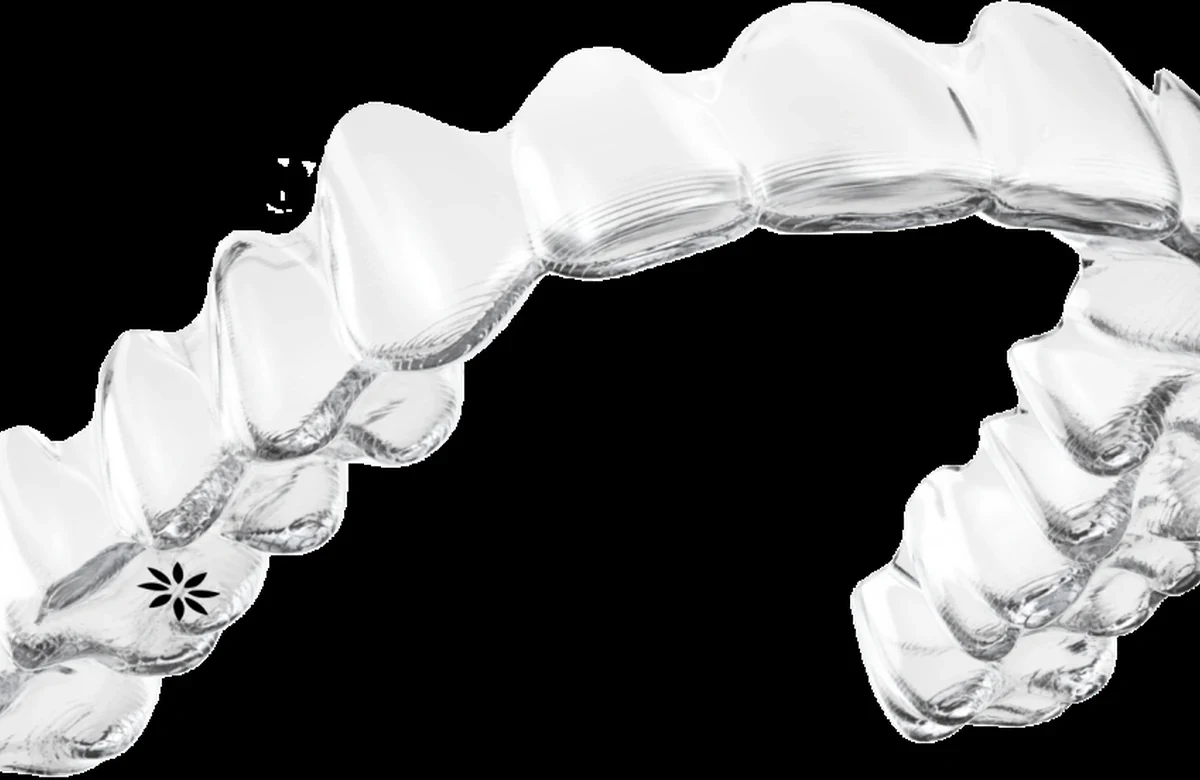
Invisalign may help where a suitable degree of dental movement can improve the slope. Attachments, aligner staging and sometimes additional anchorage or elastics may be considered as part of the plan. The clinician must take account of the roots, surrounding bone and bite.
There are limits to the predictability of vertical movements and the control available with removable appliances, especially in complex cases. A proposed simulation is therefore a treatment target, not evidence that the same movement will happen precisely in your mouth.
Ask for a realistic explanation: Which teeth would move up or down? Would that change the bite? How would the back teeth meet afterwards? What happens if a tooth does not move as planned? A clinician who can explain these points is giving you far more useful information than somebody who simply shows a perfectly straight digital line.
Invisalign also requires consistent daily wear; its UK guidance typically recommends about 20–22 hours per day, subject to the clinician's instructions. [2] If the proposed correction is demanding, wear consistency and close monitoring may be particularly important.
Could fixed braces be better?
Sometimes. Fixed appliances offer different mechanical control, and in selected cases additional devices can be used to address particular vertical discrepancies. But they are not automatically required for every uneven smile. A subtle dental cant may be treatable with aligners; a more complex discrepancy may favour another approach.
The British Orthodontic Society describes the range of fixed and removable systems and advises that appliance choice depends on the patient's orthodontic needs. [3] A strong comparison explains the movements, expected reliability, hygiene requirements, visual impact and overall time of each option.
If you are primarily interested in Invisalign, it is still worth hearing if fixed braces might produce a more predictable improvement. That does not mean your preference has been ignored. It means the plan is being judged against your actual concern rather than a predetermined product.
Is a perfectly level smile always the best aesthetic result?
Not necessarily. Our faces are not geometrically symmetrical. A tiny difference in tooth height may harmonise with a naturally uneven lip line rather than stand out. An aggressive attempt to level everything relative to an imaginary ruler can sometimes produce an artificial appearance—or demand unnecessarily complex treatment.
Ask to see the proposed result in the context of your whole face, not just a cropped image of six front teeth. Check the incisor edges, lip line and smile in motion. Consider whether the change would be noticeable to you during ordinary conversations.
There is also a difference between improving a smile and pursuing an impossible standard of perfection. The aim should be an outcome that looks natural and leaves the teeth and supporting tissues healthy.
A good clinician is willing to say, 'We can improve the dental slope, but the lip asymmetry will remain.' That is a valuable answer, not a failure to sell a treatment.
Could bonding or contouring help instead?
If the perceived slant comes from small differences in tooth length, a conservative restoration or carefully controlled enamel reshaping might be considered. Bonding can add material to a short edge; contouring can remove tiny amounts from a longer edge when safe. These options change tooth shape, not the position of the roots or the jaw.
That distinction matters. Trying to conceal a substantial dental cant by making one side's teeth much longer can distort tooth proportions and create an awkward bite. Similarly, removing enamel simply to level a photograph may compromise healthy teeth without addressing the underlying issue.
Where orthodontics would genuinely improve tooth position, it may be better to align first and make only small aesthetic refinements afterwards. If the asymmetry is very minor, you may reasonably prefer to leave it alone.
A treatment plan should show how the proposed change affects the visible tooth lengths and the way the upper and lower teeth make contact.
What should be assessed before you spend money?
A useful starting point includes a clinical examination, dental and gum health, the bite, tooth wear and photographs in natural head position. The clinician may compare the upper incisor line with your lip and facial reference points. A scan can help explain dental relationships. Further imaging is reserved for cases where it would change diagnosis or management.
You should also describe whether the appearance is longstanding or new. A gradually changing bite, increasing tooth mobility or significant wear may need a different investigation from a stable cosmetic concern present for years.
Ask for two realistic options if more than one approach is possible: perhaps aligners for a modest correction, or no orthodontics with a limited shape adjustment. Seeing the benefit, limitation and cost of each choice helps you decide without pressure.
Frequently asked questions
Why do my teeth look slanted in selfies? Camera angle and head position can magnify asymmetry. A clinician should assess the smile in person before deciding whether there is a dental cant.
Can Invisalign make one side of my smile higher? It may reposition selected teeth in suitable cases. The amount achievable depends on your anatomy and bite; a digital plan is not a guarantee.
Will braces straighten my facial asymmetry? Braces move teeth, not facial bones or muscles. More significant skeletal differences require a different assessment.
Is a slight slant bad for my teeth? Not necessarily. Aesthetic asymmetry does not automatically imply a damaging bite. Examination is needed to distinguish appearance from functional issues.
Can bonding fix it instantly? Bonding can change a tooth's apparent length, but it cannot correct the position of roots or a sloping dental arch. It should be used selectively.
Decide what improvement would mean to you
At Iconic Smiles, a £30 consultation can be an opportunity to look at your smile from the front and in motion, distinguish tooth position from lip or jaw asymmetry, and discuss realistic orthodontic or conservative cosmetic options. Confirm the current fee and the relevant clinician's availability when booking.
The most helpful outcome is not a promise of mathematical perfection. It is understanding what you are seeing, what can sensibly change and whether the result is worth pursuing.
Clinical sources and further reading
- Shani N, et al. Management of occlusal cant in skeletal Class II and Class III patients: a systematic review. BMC Oral Health, 2026.
- Invisalign UK. Frequently asked questions.
- British Orthodontic Society. Treatment and brace types.
- NHS. Braces and orthodontics.
Your next step, when you’re ready
We would be pleased to welcome you for a £30 consultation at your preferred Iconic Smiles practice. Bring your questions, and we can talk through the options that may suit you.
£30 for a planned-treatment consultation. Scans, additional investigations and emergency assessments may have separate fees; please confirm when booking.