
Invisalign and teeth straightening
Severe Underbite: When Specialist Assessment Is Needed
An underbite can arise from the positions of individual teeth, the relationship between the jaws or a combination.
Talk to us about straightening your teeth
You might have a particular change in mind, or simply want to know what is possible. At a £30 consultation, we can talk through your goals and explain how the next steps are planned.
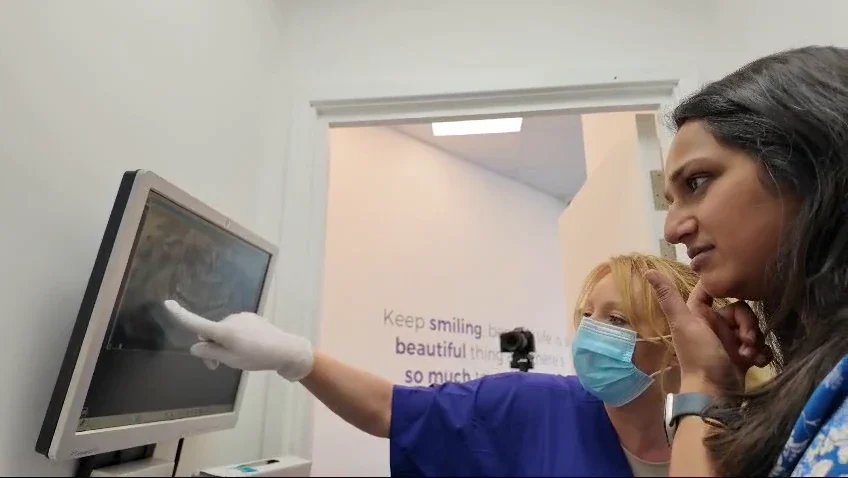
A severe underbite may need specialist orthodontic or jaw-surgery assessment when tooth movement alone cannot address the underlying jaw relationship. An underbite can come from tooth positions, the jaws or both. In a skeletal Class III pattern, the lower dental or jaw relationship is ahead of the upper. Aligners may improve visible alignment without correcting that underlying difference, so the intended functional change needs to be clear.
Diagnose the source of the discrepancy
The clinician checks front and back contacts, centrelines, facial profile and jaw position on closing. Photographs and scans help record them; selected cases need further imaging or specialist analysis of jaw and tooth relationships on X-rays. Upper-front crowding may be only one part of the findings. The jaws need assessment before a normal bite can be predicted from front-tooth movement.
What dental camouflage can and cannot do
Orthodontic camouflage moves teeth to improve contacts or appearance within the patient's skeletal relationship. In a mild, suitable case it may be an acceptable treatment choice. In a severe discrepancy, extensive tipping can compromise incisor position, periodontal support or facial aesthetics without correcting the root cause. The dentist should explain those limits with a diagram or records rather than suggesting every Class III case is an Invisalign candidate.
Specialist options in selected adults
A specialist orthodontist may discuss fixed appliances, tailored bite mechanics or an orthognathic surgical assessment where the skeletal difference is substantial. Surgery is not a routine recommendation for everyone with an underbite, and some patients prefer no treatment or limited improvement. The discussion must cover treatment burden, recovery, consent and the fact that jaw surgery is a distinct clinical undertaking, not simply a more powerful brace.
The cosmetic treatment trap
Placing veneers or crowns over severely misaligned front teeth can disguise edges but does not necessarily improve jaw function. Large preparations to mask a skeletal relationship may sacrifice healthy tooth structure while leaving an uncomfortable bite. Where the concern is primarily tooth shape, limited bonding might be suitable, but the dentist should not allow cosmetic dentistry to substitute for essential diagnosis. The patient's goals must be separated into aesthetics, speech, chewing and any symptoms.
Decide from a written comparison
Ask which component of the underbite is dental, which is skeletal, what improvement orthodontics alone can realistically deliver and when referral is warranted. The final choice should describe likely bite contacts, retention and any residual discrepancy. A specialist opinion can be the best outcome of an initial consultation even when it means the simplest advertised aligner route is not appropriate.
An underbite that cannot be solved by changing veneers
If lower front teeth sit ahead of the uppers because of a substantial jaw discrepancy, adding white veneers to bring the uppers visually forwards may create bulky proportions without improving chewing contacts. A specialist opinion may be more useful before restorative choices. One displaced front tooth with otherwise suitable jaw relationships presents a different, potentially simpler movement problem.
The comparison should show the contribution of teeth and jaws and the expected effect on appearance, biting and speech. Fixed braces, aligners, limited cosmetic camouflage and combined orthodontic and jaw-surgery assessment have different aims and commitments. You may prefer a limited improvement or accept a remaining discrepancy once the implications are explained. Include long-term retention and any reason for referral before choosing a routine aligner route.
Avoid confusing dental camouflage with jaw correction
Tilting upper and lower incisors may disguise a small jaw discrepancy in selected cases, but it does not change a pronounced skeletal relationship. For a marked underbite, the assessment may consider facial profile, growth status, incisor inclination and long-term bite stability. Referral for a specialist opinion can clarify whether braces alone are realistic or whether combined orthodontic and orthognathic assessment merits discussion.
Your next step, when you’re ready
We would be pleased to welcome you for a £30 consultation at your preferred Iconic Smiles practice. Bring your questions, and we can talk through the options that may suit you.
Any additional investigations and their fees will be explained before you decide.