
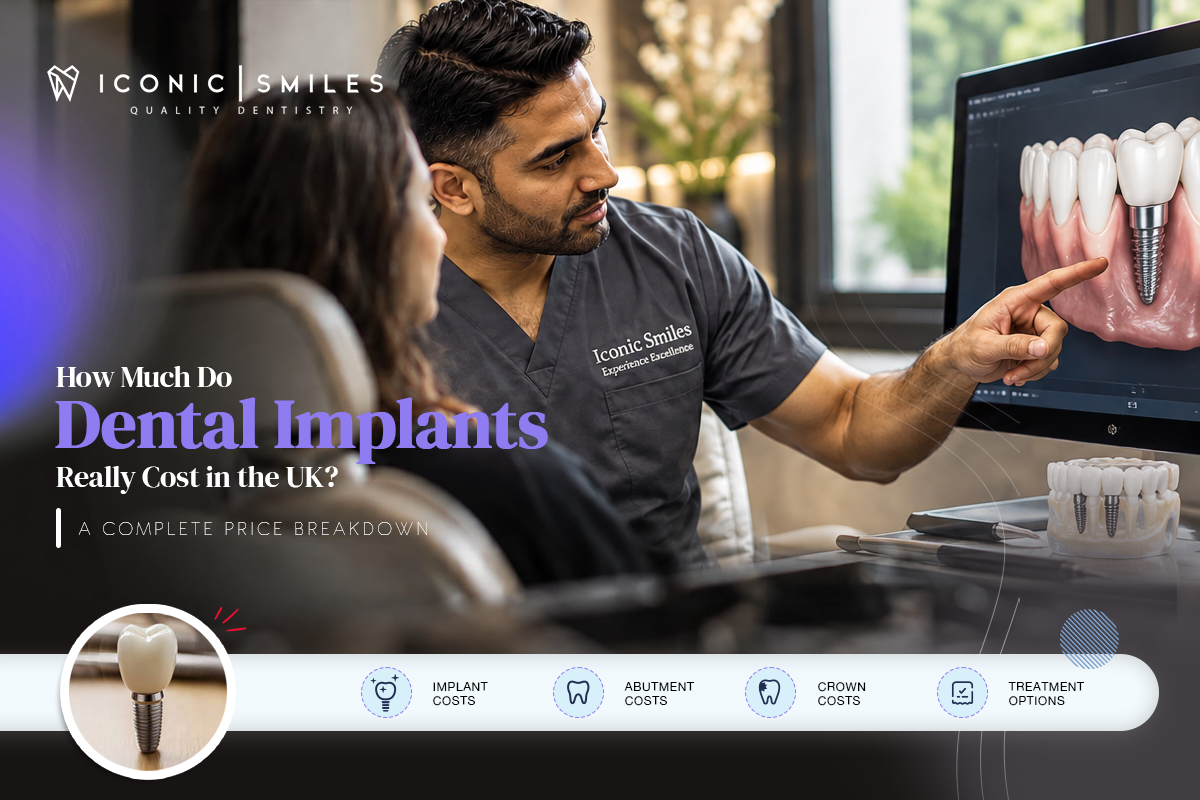
The price of a dental implant is not necessarily the price of a completed replacement tooth. A complete quotation should identify what is included from diagnosis through to the final restoration, alongside any likely additional treatment and the terms covering complications or repairs. A low headline figure is difficult to interpret until its scope is clear.
In this guide
- The elements that make up the final cost
- Why two quotations can differ substantially
- The questions worth asking before paying
- Why maintenance belongs in the financial decision
- Comparing implants with bridges or dentures
- Do not compare incomplete prices
- Value extends beyond the day of fitting
The elements that make up the final cost
A single-tooth pathway may involve consultation, imaging, extraction, provisional tooth replacement, the implant fixture, surgical placement, an abutment and a definitive crown. Other cases require a graft, soft-tissue treatment, sinus augmentation or a custom component. Full-arch treatment adds laboratory design, a temporary bridge where appropriate, the definitive prosthesis and more complex long-term servicing. Different plans may include different combinations, so written itemisation matters more than a bare “from” price.
Why two quotations can differ substantially
Bone availability, gum condition, location of the missing tooth, complexity of the bite, aesthetic demands and the design of the final restoration all affect the clinical workload. A front tooth with a delicate gum contour is not interchangeable with a back tooth restored primarily for chewing. Likewise, a fixed full-arch bridge and an implant-retained removable denture are distinct treatments with different upkeep requirements. More expensive does not automatically mean better; the plan must justify what is proposed.
The questions worth asking before paying
Ask whether the stated price includes the final crown or bridge rather than the implant fixture alone. Clarify imaging, grafting, provisional teeth, laboratory work, review appointments, hygiene, replacement of worn components and finance charges. Request a staged estimate where uncertainty remains; it is more honest to show a range for a possible graft than to imply every mouth is predictable before assessment.
Why maintenance belongs in the financial decision
Natural teeth and implants both need continuing care. Implant crowns can chip, screws can loosen and removable overdenture attachments wear. A repair may be modest or require substantial restorative work. Budget for periodic examinations and professional hygiene, and understand who will provide the service if you move practice. Financing changes when you pay; it does not eliminate the eventual cost.
Comparing implants with bridges or dentures
For a single gap, a bridge may have a lower initial fee but could involve preparation of adjacent teeth; an implant has surgery and usually takes longer. Dentures may be less invasive but differ in comfort, stability and maintenance. A clinically appropriate comparison should include consequences for neighbouring teeth, future replacement, cleaning burden and the cost of the entire pathway. The right choice is not determined by an advert alone.
Do not compare incomplete prices
A claimed cheap implant may exclude the custom abutment, crown, bone graft, provisional or professional maintenance. Conversely, a higher quotation can include items another practice bills separately. Place estimates side by side under identical headings and clarify whether “per tooth” or “per implant” describes the charge. Ask who bears the cost of a changed plan when findings during surgery differ from the initial expectation.
Value extends beyond the day of fitting
A restoration that is difficult to clean or cannot be repaired locally may cost more over time. Material choice, recognised implant-system documentation and access to future replacement components deserve explicit consideration. A practical quotation therefore describes both completion costs and foreseeable recurring upkeep, without offering a misleading lifetime-cost prediction.
Before making a decision
Ask for an individual assessment, a written plan explaining the clinically appropriate alternatives, the likely treatment sequence, important risks, maintenance requirements and the complete anticipated cost.
Frequently asked questions
Why is a crown sometimes priced separately?
The fixture, connecting component and visible restoration are separate stages and materials. Confirm whether the quoted total includes all three.
Will a bone graft always increase the cost?
If augmentation is indicated, it introduces additional materials, surgery and often appointments. Its likely price and alternatives should appear in the written plan.
Can I get an exact price online?
A website can show verified starting prices, but a reliable individual quotation requires examination and appropriate planning.
Planning treatment
An individual dental examination is needed to determine whether treatment is appropriate, compare alternatives and explain risks, likely stages and costs. Information here is educational and cannot diagnose your situation.
Evidence and further reading
- Guy’s and St Thomas’ NHS Foundation Trust — Dental implants: overview, treatment and aftercare
- Leeds Teaching Hospitals NHS Trust — Dental implants (patient guidance)
Related guides
- Dental Implants: The Complete UK Guide to Treatment, Costs, Risks and Recovery
- Dental Implants vs Bridges: Which Is the Better Long-Term Solution?
- Fixed Implant Bridges vs Implant-Retained Dentures: A Complete Comparison
- How Many Dental Implants Do You Need to Replace Multiple Missing Teeth?