
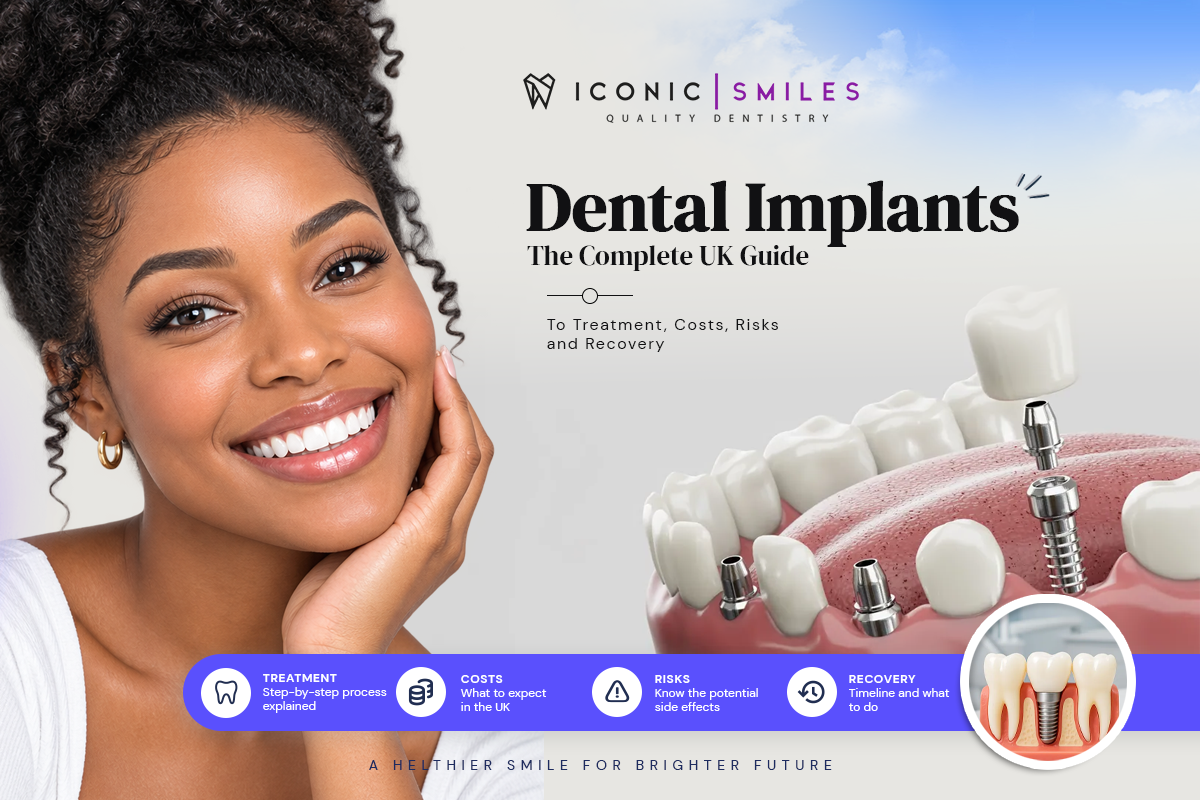
A dental implant is an artificial tooth root placed into the jawbone to support a crown, bridge or denture. It can replace one missing tooth, several teeth or, with a carefully designed restoration, an entire arch. The most important decision is not simply whether an implant can be placed; it is whether the whole treatment can be delivered, maintained and repaired in a way that suits your health, anatomy and priorities.
In this guide
- What does an implant actually replace?
- How the treatment is planned
- The stages, from planning to the final tooth
- What a meaningful quotation includes
- Risks and long-term responsibilities
- What a well-designed implant plan should prove
- Questions to take to your consultation
What does an implant actually replace?
The implant fixture sits within bone. A connecting component, often called an abutment, supports the visible tooth or teeth. These are separate elements, with separate clinical and financial considerations. An implant does not recreate a natural periodontal ligament: its loading, sensation and cleaning requirements differ from a natural tooth. A missing tooth can also be managed with a bridge, a denture or, in selected cases, by accepting the space.
How the treatment is planned
Assessment begins with a discussion of the missing teeth, your expectations, medical history, medicines, smoking, gum health and daily cleaning. Examination and appropriate imaging determine the available bone, neighbouring roots and anatomical structures. A three-dimensional CBCT scan is used when the additional information is justified; it is not automatically necessary for every patient. The replacement tooth is planned first, so implant positioning supports an accessible and aesthetically appropriate final restoration.
The stages, from planning to the final tooth
Some patients need periodontal treatment, removal of an unsaveable tooth or bone augmentation before implant surgery. Implant placement is normally carried out with local anaesthetic. Healing allows the implant surface to integrate with bone; conventional treatment commonly involves several months, although carefully selected immediate protocols exist. Restorative appointments then establish fit, bite, appearance and cleaning access. Complex treatment or staged grafting can lengthen the overall pathway significantly.
What a meaningful quotation includes
A useful written plan separates diagnostic appointments and scans, extraction if needed, grafting, surgery, implant components, provisional restorations, final crown or bridge, any sedation and follow-up. Compare equivalent completed treatments, not isolated headline prices. Check what happens if a graft or implant does not integrate, and whether repair or maintenance charges are included. Costs vary by clinical complexity and the type of final restoration.
Risks and long-term responsibilities
Possible complications include failure to integrate, infection, bleeding, swelling, altered sensation where nerves are involved, sinus-related problems in the upper jaw, aesthetic compromises and later mechanical complications. Peri-implant mucositis affects the surrounding soft tissue; peri-implantitis involves progressive supporting-bone loss. Regular maintenance and effective cleaning remain essential even when an implant feels completely comfortable. Smoking, poorly controlled diabetes and untreated periodontitis require particular attention.
What a well-designed implant plan should prove
The outcome must be judged as a complete restoration, not simply a fixture visible on an X-ray. Before surgery, the proposed final tooth position, bite, gum contours and maintenance access should be credible. A patient should understand what will happen if the site needs unexpected augmentation and what temporary tooth replacement is possible during healing.
Questions to take to your consultation
Ask which tooth-replacement alternatives are reasonable, what diagnostic imaging is clinically needed, whether treatment is staged, how temporary teeth will work, what the total quotation includes and what maintenance looks like five years later. A transparent plan gives you a decision pathway rather than a sales headline.
Before making a decision
Ask for an individual assessment, a written plan explaining the clinically appropriate alternatives, the likely treatment sequence, important risks, maintenance requirements and the complete anticipated cost.
Frequently asked questions
Is implant surgery painful?
The area is generally numbed for surgery. Tenderness, swelling or bruising afterwards varies by the procedure and usually improves over the following days.
How long does the full process take?
A straightforward case may take months; grafting, complex rehabilitation and healing requirements can extend the process. Your individual plan should specify stages rather than promise one universal timeline.
Are implants permanent?
An implant is designed for long service, but neither the fixture nor its crown is guaranteed for life. Tissue health, components, bite forces and maintenance all matter.
Planning treatment
Planning treatment
An individual dental examination is needed to determine whether treatment is appropriate, compare alternatives and explain risks, likely stages and costs. Information here is educational and cannot diagnose your situation.
Evidence and further reading
- Guy’s and St Thomas’ NHS Foundation Trust — Dental implants: overview, treatment and aftercare
- Leeds Teaching Hospitals NHS Trust — Dental implants (patient guidance)
- International Team for Implantology — Implant placement and loading protocols (consensus)
- European Federation of Periodontology — Prevention and treatment of peri-implant diseases (S3 guideline)
Related guides
- Dental Implants vs Bridges: Which Is the Better Long-Term Solution?
- How Much Do Dental Implants Really Cost in the UK? A Complete Price Breakdown
- Dental Implant Recovery: What to Expect During the First 24 Hours, 7 Days and 6 Months
- Dental Implant Maintenance: How to Protect Your Investment for Decades