
Bonding, veneers and whitening
Enamel contouring for uneven tooth edges: small changes and limits
Considering small changes to tooth shape? Understand enamel contouring, its irreversible limits and how it compares with bonding or tooth straightening.
Discover what could suit your smile
Whether you are thinking about colour, shape or a subtle change, a £30 consultation is a welcoming place to share your ideas, ask questions and explore a personalised approach.
£30 for a planned-treatment consultation. Scans, additional investigations and emergency assessments may have separate fees; please confirm when booking.
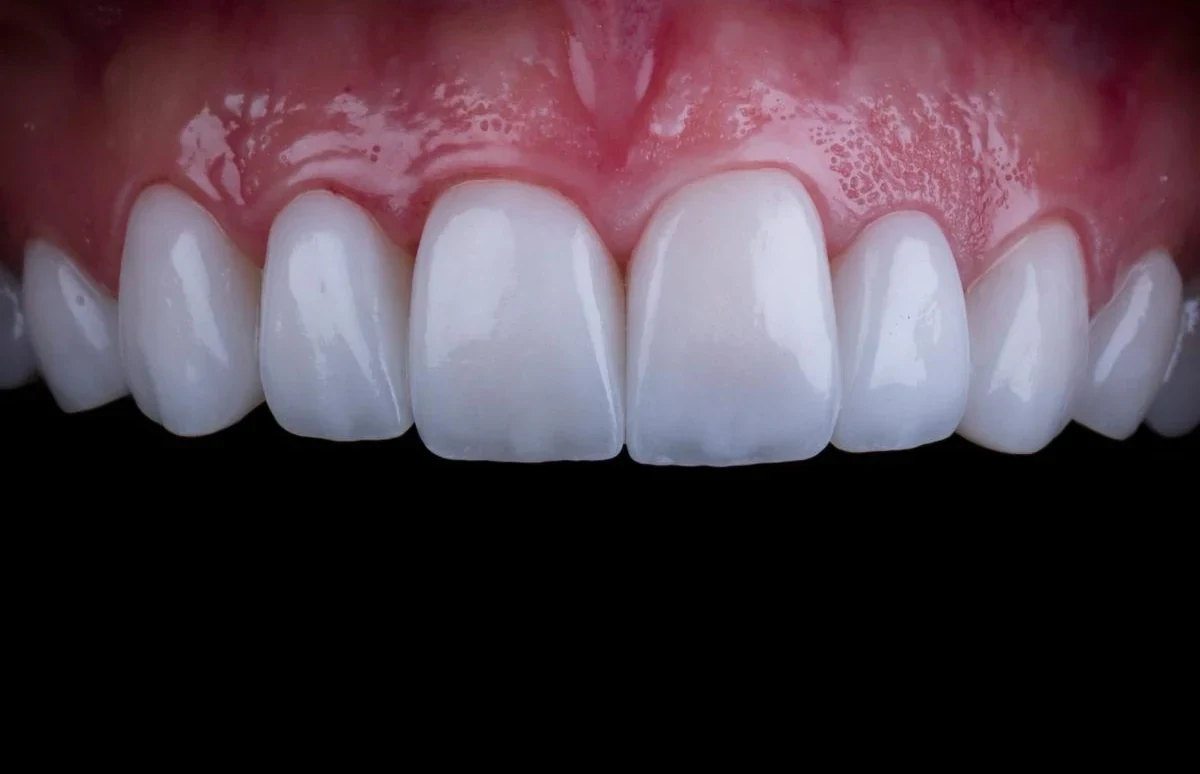
Sometimes the detail that bothers you is no bigger than the edge of one tooth. A front tooth looks a fraction longer than its neighbour. A canine has a sharp point. A slightly uneven edge catches the light when you smile. You may not want veneers, bonding or months of orthodontics to change something so small.
Enamel contouring, also called enameloplasty or cosmetic tooth reshaping, is one possible option. A dentist carefully removes a very small amount of enamel to refine a tooth's shape. For the right tooth and the right concern, that can make the smile look more balanced without adding a restoration. But the simplicity is easy to misunderstand: enamel does not grow back. A modest procedure is still an irreversible one.
The best decision depends on whether the problem really is excess enamel in a safe place, or whether something should be added, aligned or left alone instead.
What can enamel contouring actually change?
Think about the outline of a tooth rather than its position. Contouring can smooth a slightly irregular incisal edge, soften a pronounced corner, refine a minor length difference or make a pointed tooth appear less sharp. Where the discrepancy is small, the effect can be surprisingly noticeable because the eye follows the line formed by the edges of the front teeth.
What contouring cannot do is move a tooth's root, make a short tooth longer, close a substantial gap or correct a deep bite. It also does not bleach discoloured enamel. Those goals involve other treatments, and sometimes no treatment at all is necessary.
The Cleveland Clinic describes enameloplasty as the controlled removal of tiny amounts of enamel to change tooth size or shape, usually for minor cosmetic concerns. [1] The key words are tiny amounts. If a meaningful improvement would require a large reduction, a responsible dentist should consider whether a different approach would be safer.
A beautiful result is usually subtle. Someone looking at you may notice that your smile feels more balanced without being able to identify which tooth was changed.
Why can a millimetre—or less—make such a difference?
The visible edges of the upper front teeth help create the curve of the smile. Their relative lengths also influence how youthful, soft or angular the teeth appear. A small asymmetry can draw attention because the two central incisors sit next to each other and are naturally compared by the eye.
But there is no universal formula for perfect tooth lengths. Your facial proportions, lip movements, tooth shape and personal taste all affect what looks right. Making every front tooth exactly level may look artificial if your smile naturally has some variation.
It helps to evaluate the teeth while you speak and smile rather than only in an exaggerated close-up. The dentist might mark or demonstrate the proposed outline before removing anything. This is especially valuable when the change is irreversible.
If you are unsure whether the difference bothers you enough, you can simply take time to consider. An elective procedure does not become urgent because it could be completed in one visit.
How does the dentist know whether there is enough enamel?
Enamel is the hard outer layer of the tooth. Its thickness varies around the crown and from person to person. Once removed, it cannot regenerate. Underneath lies dentine, which is more sensitive and is not intended to be exposed by cosmetic reshaping.
The dentist needs to examine the tooth, its surface, the bite and any signs of existing wear, chipping or sensitivity. Where clinically appropriate, records or imaging may help establish whether reduction would be safe. The same visible edge can have plenty of intact enamel in one person and a thin, worn surface in another.
A key question is how much material needs removing to achieve the proposed improvement. The answer should be small, specific and compatible with the health of that tooth. Avoid accepting broad assurances that enamel can simply be 'filed down' without consequences.
The British Orthodontic Society has emphasised that removing too much enamel during a related technique, interproximal reduction, can harm teeth and requires professional judgement. [2] That statement concerns enamel removal between teeth, not cosmetic edge contouring, but the underlying principle of restraint is relevant.
Is cosmetic contouring the same as interproximal reduction?
No. Enamel contouring in this context generally means refining the visible outline or surface shape of a tooth. Interproximal reduction, often shortened to IPR, means removing a carefully measured amount of enamel from the sides of selected teeth, usually to create space for orthodontic alignment or adjust tooth shape.
IPR may sometimes be part of an Invisalign plan, but it has different objectives and requires a different explanation. If a treatment proposal includes IPR, ask where it will be performed, how much is planned and why that space is necessary. It should not be presented as identical to smoothing a tiny corner of one front tooth.
A 2022 systematic review found no clear increase in several adverse outcomes in the small body of studies it evaluated, but judged the overall evidence quality low to very low. [3] That is a reason for careful, measured technique, not permission for casual enamel removal.
You should understand which procedure is being proposed, particularly if the terms 'reshaping', 'stripping' and 'contouring' are used loosely.
When might bonding be the more conservative option?
This sounds counterintuitive, because contouring is often described as minimally invasive. But adding a small amount of composite may sometimes preserve more natural tooth structure than removing enamel to create the same visual effect.
Suppose your right central incisor looks shorter because of a small chip. Filing down the left tooth to match it would sacrifice healthy enamel. Restoring the shorter edge with composite might preserve both teeth more appropriately. Alternatively, if one tooth is genuinely longer with a healthy edge and only slight reduction is needed, contouring may be simpler than adding material elsewhere.
The distinction is between solving the appearance by subtraction or addition. Neither is automatically better. Bonding brings its own maintenance, staining and repair considerations. Contouring removes a small amount of tooth permanently but does not create an added restoration that could chip.
Ask to see both approaches if the choice is not obvious. A good clinician should prefer preserving healthy tissue while achieving a result that looks convincing and functions comfortably.
What if the tooth only looks longer because it is out of position?
A tooth that tilts forward, is rotated or has erupted to a different height may seem too long or uneven compared with its neighbour. Simply shortening the visible edge could mask the appearance while leaving the actual position unchanged. Depending on the bite, that may also remove enamel that would be better preserved.
Invisalign or another orthodontic approach may be worth considering if tooth position is the underlying issue and you would like to address it. On the other hand, it would be disproportionate to suggest months of orthodontics for every harmless minor irregularity.
The sensible question is whether the shape difference comes from anatomy, wear or alignment. Once the cause is clear, you can compare a very small contouring procedure with additive bonding, orthodontics or doing nothing.
For patients who already plan orthodontics, final edge refinements are often considered at the end, when the teeth are in their intended positions. That avoids removing enamel to compensate for a relationship that is about to change anyway.
Does enamel contouring hurt?
When only superficial enamel is involved and the technique is appropriate, the procedure may require no local anaesthetic. Enamel itself does not contain the same sensory structures as dentine. However, sensations differ, and nearby sensitive areas or an unusual tooth surface may affect comfort.
You may feel vibration or hear the sound of polishing instruments. The dentist should explain what they are doing and stop if you experience unexpected discomfort. If reducing the planned area would likely expose dentine or cause a problem, the correct response is to reconsider the treatment, not simply apply more anaesthetic and carry on.
Some people notice temporary sensitivity afterwards, although that should not be dismissed if it persists. The Cleveland Clinic advises that excess enamel removal can weaken teeth and increase the risk of sensitivity and other complications. [1]
It is reasonable to ask how the final surface will be smoothed and polished. A well-finished edge should not feel jagged against your lips or tongue.
Will the changed tooth look natural?
Usually that is the aim. The dentist should consider the relationship between the central incisors, the neighbouring lateral incisors and the canines rather than creating an isolated perfect-looking shape. Natural teeth have individual character; softening one conspicuous point can be enough without erasing it completely.
Ask whether the contouring will change how the upper and lower teeth meet. A tooth edge is not purely decorative: it may take part in biting and guidance during jaw movements. Altering it can change contact patterns, especially where there is a deep bite or tooth grinding.
A subtle finish can also avoid the 'flat line' appearance that comes from trimming all front teeth to identical lengths. You are not trying to manufacture uniform tiles. You are refining the way natural teeth relate to one another.
If your clinician proposes reducing several healthy teeth, it is fair to ask whether an alternative would produce a similar improvement with less irreversible change.
Can teeth whitening be combined with contouring?
Yes, but sequence and objectives matter. Whitening changes the colour of natural teeth; contouring changes their shape. If you are planning both, the dentist should explain which to do first and whether a period of colour stabilisation is appropriate before any bonding or other restorative work.
Small enamel irregularities sometimes become more or less visible after surface stains are removed. A professional assessment can help you determine whether a change you dislike is truly about shape or partly about the way stain catches on an uneven edge.
Be cautious about cosmetic packages that combine several procedures without individual reasons. A patient seeking a tiny change to one corner should not automatically be sold whitening, bonding and multiple veneers. A simple, well-executed improvement can be the most sophisticated outcome.
What are the disadvantages and risks?
The principal limitation is irreversibility. Enamel cannot be replaced naturally once it has been removed. Excess reduction can cause sensitivity, expose dentine, alter contact points and weaken areas of the tooth. Poor finishing may leave a rough edge; inappropriate changes can also affect the bite.
There may be little ongoing maintenance of the altered outline itself, but that does not mean the tooth is immune to wear, chipping or future dental problems. If you grind your teeth, an already vulnerable edge may need protection or a different treatment plan.
The best way to reduce risk is an appropriate examination, a conservative design, clear consent and careful finishing by a trained professional. Do not attempt to file your own teeth or use beauty tools marketed for DIY reshaping. The damage may not be repairable without adding restorative material later.
If a clinician says the desired improvement requires more enamel removal than is safe, that is a reason to reassess the goal. It is not an invitation to find someone willing to remove more.
Frequently asked questions
Can contouring make my two front teeth the same length? It may help with a very small difference if the longer tooth has suitable enamel. Sometimes adding composite to the shorter tooth is more conservative.
Does enamel grow back? No. Removed enamel does not regenerate, which is why the planned reduction must be carefully justified.
Can it fix pointed canine teeth? A small tip refinement may be possible, but the canine's role in your bite and the remaining enamel must be considered.
Is it cheaper than bonding or veneers? Fees vary. Compare the treatment objective and biological cost as well as the quoted price; the least expensive option is not always the most suitable.
Will I need an injection? Not always for very superficial enamel shaping, but comfort and clinical circumstances vary.
Ask for the smallest sensible change
An Iconic Smiles £30 consultation can help you explore whether the detail that bothers you would benefit from enamel contouring, a tiny addition of composite, tooth alignment—or simply reassurance that your smile is already naturally balanced. Confirm current fees and available treatments when booking.
A worthwhile cosmetic change should be measured not only by how it looks afterwards, but by how much healthy tooth has been preserved to achieve it.
Clinical sources and further reading
- Cleveland Clinic. Enameloplasty: benefits, limitations and side effects. Medically reviewed 2024.
- British Orthodontic Society. Statement on interproximal enamel reduction.
- Gómez-Aguirre JN, et al. Effects of interproximal enamel reduction techniques used for orthodontics: systematic review. Orthodontics & Craniofacial Research, 2022.
Your next step, when you’re ready
We would be pleased to welcome you for a £30 consultation at your preferred Iconic Smiles practice. Bring your questions, and we can talk through the options that may suit you.
£30 for a planned-treatment consultation. Scans, additional investigations and emergency assessments may have separate fees; please confirm when booking.