
Bonding, veneers and whitening
Large front-tooth fillings: when might a crown suit better than a veneer?
Understand how remaining tooth structure affects the choice between a veneer and a crown for a heavily filled front tooth, before cosmetic treatment.
Discover what could suit your smile
Whether you are thinking about colour, shape or a subtle change, a £30 consultation is a welcoming place to share your ideas, ask questions and explore a personalised approach.
£30 for a planned-treatment consultation. Scans, additional investigations and emergency assessments may have separate fees; please confirm when booking.
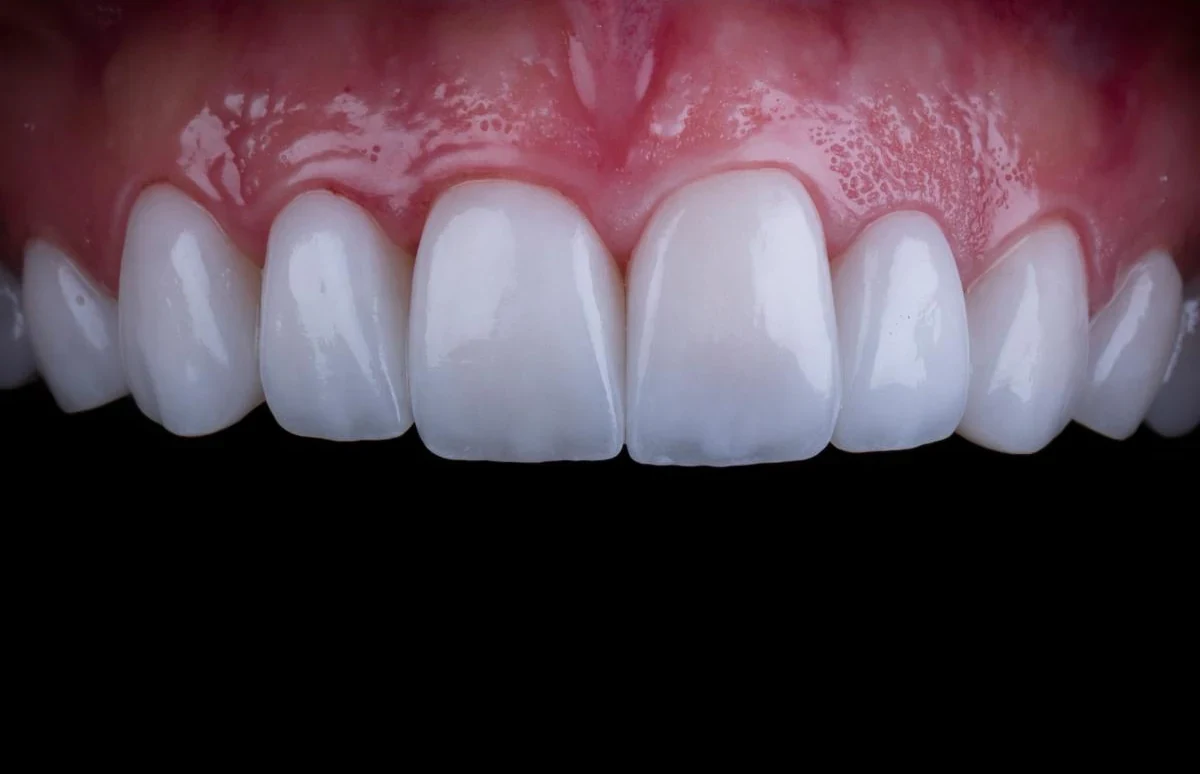
A front tooth with a large white filling can look healthy from a distance. Yet if the filling has been replaced several times, you may be unhappy with its colour, shape or tendency to chip. Perhaps you have been offered a porcelain veneer to improve the appearance, but another dentist has suggested a crown. It can be difficult to understand why the plans differ, especially when both promise an attractive, tooth-coloured result.
The real distinction is not that veneers are cosmetic and crowns are strong. Both can be aesthetic restorations, and neither should be chosen without examining the tooth. A veneer typically covers part of its visible surface; a crown surrounds a greater proportion of the tooth. The best decision depends on how much sound enamel and dentine remain, the size and position of existing fillings, the tooth's bite forces, whether it has had root canal treatment and what you want to change.
Why the amount of natural tooth matters
Adhesive dentistry relies on the substrate to which the new restoration is attached. Sound enamel provides a different bonding environment from a large existing composite filling or exposed dentine. A veneer may function predictably when there is adequate suitable tooth surface and a conservative design. Where a large proportion of the visible front face is already filled, the available enamel may be reduced and the risk profile different.
This does not automatically require a crown. A tooth with a substantial filling may still have enough sound structure for a carefully planned partial restoration or a new direct composite build-up. The clinician should map where the filling lies and how much healthy tooth remains. A very large filling hidden under an apparently attractive surface needs more consideration than its cosmetic colour alone suggests.
A retrospective veneer study found that the extent of enamel preservation was strongly associated with survival, although the evidence is observational and cannot predict the outcome for one patient [1]. The lesson is not a rigid rule but a useful question: what will the new restoration actually bond to?
What exactly does a veneer cover?
A veneer is usually a thin facing placed on the front of a tooth, sometimes extending over the biting edge or around limited adjacent surfaces according to design. It can change shape, colour and certain surface irregularities. Some veneers need little or no preparation; others require controlled reduction of enamel to accommodate the material without creating a bulky result. The NHS explains that preparation requirements vary [2].
A veneer is not a protective shell for every damaged tooth. If the underlying structure is extensively compromised, a thin facing may not address the structural weakness or the way forces pass through the remaining tooth. The exact extent of the old filling and the condition of the tooth determine whether a veneer is a reasonable option.
Ask to see a drawing or photograph showing which surfaces would be covered and why. It can clarify whether a proposed veneer would bond mostly to enamel or partly to old filling material, and whether the chosen design would leave vulnerable unsupported edges.
What does a crown add—and what does it sacrifice?
A crown covers a greater proportion of the tooth, providing a different form of restoration when extensive tooth structure is missing. It can be appropriate for some heavily restored or root-treated teeth, depending on remaining tooth, bite and aesthetic requirements. However, crown preparation is usually more extensive than a small additive composite repair or a conservative veneer. That is a significant trade-off when healthy structure is still present.
The dentist needs to assess whether there is enough sound tooth above the gum to support the crown predictably, whether margins can be placed in a maintainable position and what risks exist for the underlying tooth. Simply crowning a tooth does not guarantee that it cannot fracture or develop decay. A crown also has to be replaced or maintained over time if problems arise.
Ask what specific structural benefit a crown would offer your tooth compared with replacing the filling, adding bonding or fitting a veneer. The explanation should relate to the clinical findings rather than a blanket claim that crowns last longer in every front-tooth situation.
Could a new composite filling be the most sensible choice?
Sometimes the simplest intervention is to remove defective filling material and replace it with well-designed composite, preserving as much sound tooth as possible. Modern tooth-coloured resins can be shaped and polished to improve the appearance of a front tooth, although staining, wear or future repair may be expected. For a tooth with adequate structure, this can provide a conservative and adaptable solution.
The difficulty is that repeatedly replacing a large filling may gradually reduce the remaining tooth and can become less predictable when there is substantial missing structure or high biting force. The aim is not to repeat the same repair indefinitely without considering why it is failing. A dentist should distinguish a cosmetic mismatch from a mechanical problem and explain whether a direct restoration remains sensible.
If you are happy with a natural look and prefer to avoid additional enamel preparation, ask whether a carefully planned new composite would achieve your goal. The answer may be yes in selected cases. A practice offering high-end ceramics should still be willing to discuss this less invasive route.
What if the tooth has had root canal treatment?
A root-treated front tooth may have a large restoration and a different underlying shade. Its structural needs depend on the amount of tooth remaining, the quality of existing root treatment, any post or core and the bite. Not every root-treated front tooth needs a crown, and not every darker tooth requires a veneer. Internal whitening, external whitening of neighbouring teeth or direct composite may sometimes be considered according to circumstances.
The clinician should evaluate radiographs, remaining structure and any symptoms before deciding on a cosmetic restoration. If the tooth itself requires further clinical care, improving the visible colour should not distract from that need. The NHS describes root canal treatment as a method of treating infection within a tooth, followed by an appropriate filling or crown to seal and restore it [2].
A dark underlying tooth can influence how translucent a veneer will appear. A more opaque ceramic or different design may be necessary, which can alter the amount of space required. This is a reason to discuss aesthetics and structure together rather than judge the best material from a photograph.
Why the bite is often the deciding factor
Front teeth are not decorative panels. They help bite into food and can guide jaw movements. A large existing filling that repeatedly chips may indicate heavy contact, tooth position or bruxism. A veneer placed into the same unfavourable contact might also fracture. A crown has its own technical limitations and cannot overcome every mechanical problem simply by covering more surfaces.
The dentist should assess contacts when you close and slide your jaw. If the bite is very deep or edge-to-edge, orthodontics or bite management may sometimes be useful before committing to a final restorative shape. Where grinding is present, a protective appliance may be considered. The NHS notes that bruxism can be associated with fractures and damaged fillings [3].
Tell the clinician about previous repairs, how long they lasted and whether you habitually bite hard objects. These details help reveal the demands the new restoration must withstand. A restoration should be designed for the way you actually use your teeth, not merely the way they look at rest.
How much tooth preparation is appropriate?
The least invasive solution is often desirable, but preparation should be judged by the restoration it supports. A veneer placed with no preparation may become bulky if the tooth already projects forward. A crown placed with excessive reduction may sacrifice valuable structure. The chosen design should be based on the existing shape, the material thickness needed and the amount of healthy enamel and dentine available.
Ask for a tooth-by-tooth explanation of expected preparation and whether it is irreversible. You should know the options before any drilling begins. If the recommendation is for a crown, ask what makes a conservative restoration unsuitable. If it is for a veneer, ask whether enough tooth surface remains for the proposed bonding strategy.
The NHS emphasises that veneers are facings fitted to teeth, with variable preparation needs [2]. Research comparing long-term veneer outcomes also shows that fractures and debonding can occur [4]. These facts support shared decision-making rather than one material being marketed as automatically superior.
How do colour and neighbouring teeth influence the plan?
A single front restoration is often hardest to match. Natural enamel varies in translucency and surface detail, and existing fillings can make the underlying tooth look different. A ceramic veneer or crown can be designed to match neighbouring teeth, but the dental technician may need detailed photographs and shade information. It may be wise to discuss whitening before choosing the final restoration shade because whitening changes natural teeth, not ceramics or existing composite fillings [5].
Ask whether you want one tooth restored or a broader cosmetic change. Treating a single tooth conservatively may be perfectly satisfactory even if it cannot be made mathematically identical to its neighbour. Conversely, if several front teeth have discoloured restorations, the dentist may discuss a coordinated shade strategy without necessarily replacing them all.
A convincing plan respects the character of the natural smile. Surface texture and small differences can make a result look more believable than perfectly flat, opaque white front teeth.
Understanding the long-term repair pathway
Composite fillings can often be modified or repaired, but large repairs may have limitations. Veneers can sometimes be repaired, polished or replaced depending on the problem. Crowns may need replacement if their margins, supporting tooth or material are compromised. None should be promised as maintenance-free or guaranteed forever.
Systematic reviews of porcelain veneers report generally favourable survival across selected clinical studies, alongside real risks of fracture, debonding and other complications [4]. Those figures cannot be directly applied to a heavily restored individual front tooth without considering its structure and bite. Ask what the clinician expects to monitor and what would happen if the restoration fails.
Also discuss how the margins will be cleaned and whether the gum can remain healthy. A restoration that looks perfect on fitting day but cannot be kept clean is not a satisfactory long-term solution.
What should the treatment plan show?
A useful plan describes the state of the underlying tooth, the size of the existing filling, the proposed restoration, the amount of preparation and the alternatives considered. It should identify whether the goal is primarily cosmetic, structural or both. Ask which aspects of the result are predictable and which are subject to limitations, such as a dark underlying shade or existing bite wear.
Review the fees as well as the biological costs. A crown might be more expensive upfront and involve more preparation; replacing a large filling repeatedly can also carry costs and risks. Choose based on the likely benefit and clinical rationale, not simply on price or on the appeal of the word 'porcelain'.
If you receive different recommendations from two dentists, ask them to explain the remaining tooth structure and bonding substrate. That often reveals why their judgements differ and where further examination might clarify the best choice.
Questions patients frequently ask
Is a veneer always more conservative than a crown? It often covers less tooth, but suitability depends on the remaining enamel, filling size and bite. Some teeth need a different design.
Can a large white filling be replaced with new composite? Sometimes. A careful assessment determines whether there is adequate supporting structure and whether repeated failure suggests a more fundamental issue.
Will a crown protect a tooth permanently? No. Crowns can experience decay at margins, technical failure or problems with the underlying tooth. Proper maintenance remains important.
Does a root-treated front tooth always need a crown? Not automatically. The remaining structure, existing restoration, appearance and functional demands guide the choice.
Can whitening improve the match before treatment? It may improve natural teeth, but it will not bleach ceramic or composite. Shade planning should account for this distinction.
Preserve the tooth before perfecting the photograph
An Iconic Smiles consultation can compare composite repair, veneers and crowns after assessing the existing filling and bite. The editorial brief refers to an introductory £30 consultation; verify the current price and whether radiographs or detailed cosmetic records are additional. The best plan is one that improves your confidence while protecting as much viable tooth structure as clinically reasonable.
Clinical sources and further reading
- Study — Enamel preservation and porcelain veneer failure risk
- NHS — Dental treatments, veneers, crowns and root canals
- NHS — Teeth grinding
- Systematic review — Porcelain veneer survival and complications
- Leeds Teaching Hospitals NHS Trust — Tooth whitening and restorations
General information only. The choice of restoration and expected longevity require individual clinical assessment; references describe selected patient groups.
Your next step, when you’re ready
We would be pleased to welcome you for a £30 consultation at your preferred Iconic Smiles practice. Bring your questions, and we can talk through the options that may suit you.
£30 for a planned-treatment consultation. Scans, additional investigations and emergency assessments may have separate fees; please confirm when booking.