
Bonding, veneers and whitening
Natural tooth character in a smile makeover: avoiding identical teeth
Explore how individual tooth shape, texture and colour can be retained in a smile makeover, with practical questions about a natural-looking design.
Discover what could suit your smile
Whether you are thinking about colour, shape or a subtle change, a £30 consultation is a welcoming place to share your ideas, ask questions and explore a personalised approach.
£30 for a planned-treatment consultation. Scans, additional investigations and emergency assessments may have separate fees; please confirm when booking.
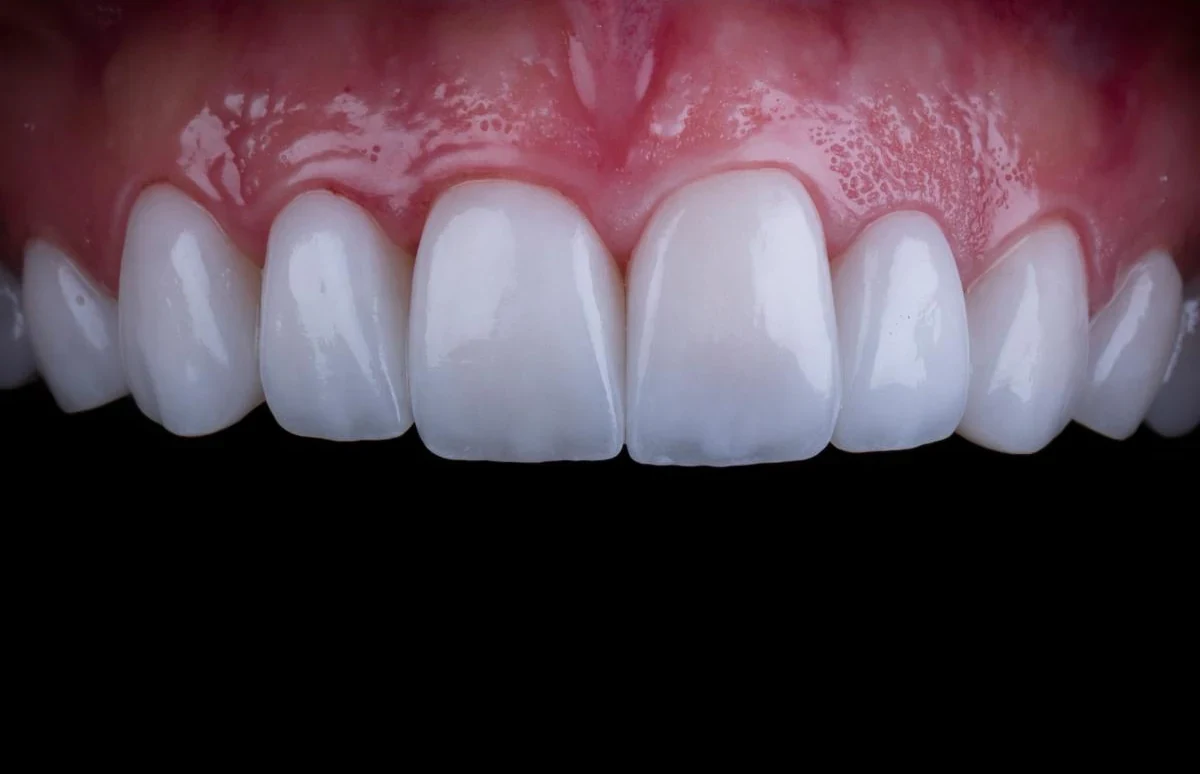
When people say they want natural-looking cosmetic dentistry, they often mean something more specific: they do not want anyone to look at them and immediately notice the dentistry. They want friends to notice that they look well, not that every tooth has become the same bright rectangle.
Yet naturalness is difficult to order from a photograph. A smile is a collection of individual teeth, shaped by lips, gums, facial expression and the way light moves across surfaces. Making every tooth the same width, length or colour may create visual uniformity, but uniformity and beauty are not synonymous.
A thoughtful smile design asks where consistency matters and where small differences give a face its character. The aim is not to add imperfections for effect. It is to preserve appropriate variations and avoid treating healthy teeth merely because a computer-generated design makes them look different.
Your teeth have different jobs — and naturally different shapes
Your two central incisors are usually the visual anchors of an upper smile. The lateral incisors next to them are commonly a little smaller and may have softer contours. Canines often have more pronounced forms because their shape and function differ from the incisors. Moving further back, premolars add depth to the smile rather than behaving like another row of flat front teeth.
There is considerable normal variation. One person's lateral incisors may be rounded; another's may be more angular. Small changes in tooth inclination can alter the apparent width. Teeth also differ in how their edges transmit light, especially when the enamel is naturally translucent.
A clinician should assess these individual characteristics before proposing veneers or composite. If all the teeth are made the same length and squareness, the smile may appear manufactured even if each restoration is technically sound. Conversely, exaggerating difference for the sake of 'character' can look artificial too. A good result usually involves restraint.
The most useful question is: which natural features do you want to keep?
Why identical white teeth can look less convincing
Natural enamel is not opaque paint. Light enters it, scatters and interacts with the dentine beneath. The edges of some front teeth are more translucent; tiny surface contours break up the reflections. Teeth often have a subtly warmer area near the gums and a different brightness towards the biting edges.
When a restoration is excessively opaque and uniform, the tooth can read as a flat surface. Extremely straight edges may form a conspicuous continuous line when someone smiles. An identical shade across every tooth may also highlight the mismatch between teeth and the surrounding facial features.
This is not an argument against bright smiles. Some patients genuinely prefer a very pale shade, and that can be a legitimate aesthetic preference. It is an argument for making the implications explicit. Ask whether the proposed shade and shapes are intended to look natural at conversation distance, in different lighting and in photographs, rather than just impressive on a screen.
The same applies to texture. A believable surface need not look rough; it should interact with light in a way that sits comfortably with the rest of your mouth.
Think about proportions, not a mathematical formula
You may have seen online rules describing a ‘golden ratio’ for front teeth. They can make attractive graphics, but real smiles do not follow one ideal numerical template. The appearance of tooth width depends on perspective, tooth rotation, smile curvature and how much of each tooth is visible from the front.
A sensible dentist may use measurements as a starting point, particularly when planning symmetry around the two central incisors. Those measurements should then be tested against the face and the patient's preferences, not treated as a law. Aesthetic research shows that perceptions of smile attractiveness are influenced by multiple features, including the amount of gum visible during a dynamic smile; it does not establish one universal prescription for every person. [1]
Instead of asking ‘Are these teeth in the ideal ratio?’, try ‘Does the overall balance look harmonious when I talk and laugh?’ That question is harder to reduce to a marketing diagram, but it is more closely connected to everyday life.
Preserve the relationship between tooth shape and the lips
A smile is framed by the upper and lower lips. Some people reveal nearly all their upper incisors while smiling; others show only part of them. The visible curve of the incisal edges can complement the lower lip. Teeth that look proportionate with lips retracted for a dental photograph may appear too long or too prominent during an ordinary smile.
During a consultation, it can help to look at short video clips, not just static images, and to compare relaxed speech with a full smile. Your normal expressions may reveal details that a posed photograph hides. A plan should accommodate the face you use every day rather than a fixed 'perfect smile' pose.
There are limits. If teeth are very short from wear, adding length may interfere with your bite or speech. If a proposed shape is too wide, it may crowd neighbouring teeth or create difficult cleaning spaces. Aesthetic preference and function need to agree before permanent changes are made.
Where small asymmetries are worth retaining
Small differences between left and right sides are ordinary. One lateral incisor may be marginally narrower. The gum outline may differ slightly. A canine may sit a little more forward. Depending on the degree and your feelings about it, those features can make a smile recognisably yours.
Some asymmetries are worth changing: a chipped incisal edge, a distracting gap or a conspicuously irregular tooth may draw the eye in a way you do not like. Others are so subtle that eliminating them requires unnecessary treatment. A discerning plan identifies the difference between the two.
Ask the clinician to show you which asymmetry they propose correcting and why. What would the untreated version look like? Can one small composite addition achieve the change? Would orthodontic movement preserve more tooth structure? Could the feature simply be left alone? Those choices are often more valuable than the number of veneers in a proposed package.
What makes a natural-looking veneer different?
Ceramic can be shaped and characterised to reproduce subtle aspects of natural teeth. The dental technician may use layers of differing translucency, local colour variation and fine surface morphology. But the process is constrained by the underlying tooth shade, the material selected, the space available and the need to preserve enamel.
A thin veneer over a very dark tooth has different requirements from a veneer over a healthy, evenly coloured incisor. If opacity is used to mask the background, the restoration may need design compromises. Likewise, a very long veneer may look attractive in a smiling photograph yet require a functional adjustment.
Long-term research on ceramic laminate veneers reports good survival in appropriately selected cases but acknowledges technical, aesthetic and biological complications. [2] The lesson is that veneers are lasting restorations with real maintenance implications, not harmless decorative shells. They should not be the default treatment for a tooth that already looks entirely acceptable to you.
A natural finish is therefore the outcome of proper case selection as much as artistic craftsmanship.
Could bonding or whitening achieve your goal more simply?
Yes, sometimes. If the teeth are healthy and the issue is a slightly uneven edge or a small gap, direct composite bonding may allow a modest addition without preparing every visible tooth. If the main concern is general shade, dentist-supervised whitening may change the appearance without covering the teeth. [3] If alignment is the issue, orthodontics may reposition teeth and reduce the need for restorations.
These treatments have different limitations. Whitening cannot bleach existing restorations; composite can stain or chip and may require polishing; orthodontics takes time and usually requires retainers. But a good cosmetic consultation should compare them before offering a uniform solution.
It may even be best to do nothing. Many people have balanced, healthy teeth with individual characteristics that simply do not resemble heavily edited online images. Cosmetic treatment should improve something you care about, not solve a problem created by a filter.
Build a design brief in ordinary language
You do not need to know dental terminology. Tell your dentist: 'I like my tooth colour but dislike this chipped corner', or 'I want my smile to look fresher, but please keep the shapes individual.' Show two or three reference photographs if they communicate your preferences, but recognise that another person's teeth cannot be transplanted visually onto your face.
Ask the dentist to reflect your preferences back to you. Which two features matter most? Which features should not change? Where is the acceptable trade-off between whiteness and translucency, symmetry and personality, or speed and conservatism?
A physical trial smile or temporary mock-up may help you judge shape in the mirror and during conversation. Some methods are approximate and may look bulkier than final restorations. They are communication aids, not guarantees. If a trial appearance worries you, that is useful feedback before irreversible steps.
Get clarity on what cannot be predicted precisely. The most professional answer is often 'we can aim for this effect, but these are the limits', rather than promising to reproduce a retouched photograph exactly.
How to recognise careful, rather than excessive, treatment planning
Consider a proposed makeover involving eight perfectly uniform veneers. Ask what happens if you treat only the two teeth that actually concern you. You may discover that the dentist has a sound reason for including more teeth, such as major shade inconsistencies or a complex bite. Equally, you may discover that the wider plan is elective rather than necessary.
Neither a small plan nor a large plan is automatically correct. The important factors are explanation, proportionality and consent. The Care Quality Commission's guidance on dental consent emphasises that patients need enough information about benefits, risks, alternatives and costs to make a voluntary choice. [4]
You should have opportunities to change your mind while planning, and sufficient time to consider any step involving permanent enamel removal. An attractive result loses much of its value if you were not genuinely comfortable with the decision that produced it.
Frequently asked questions
Should the two front teeth be identical? They often benefit from visual balance, but tiny natural differences can be perfectly acceptable. Your preferences and the existing anatomy matter.
Is a brighter shade less natural? Not inevitably. Opacity, surface texture, tooth shape and harmony with the face matter as well as shade.
Can a trial smile look different from the final result? Yes. It helps assess a proposed direction but may not reproduce final material translucency, surface detail or exact thickness.
Will a dentist leave some teeth completely untreated? That can be a sensible outcome when those teeth are healthy and already contribute to the result you want.
What if I prefer an unmistakably cosmetic look? You can discuss that honestly. Your dentist should explain the practical and biological implications without imposing a single idea of beauty.
A smile that still looks like you
The most convincing cosmetic dentistry often involves knowing when to stop. At Iconic Smiles, a £30 consultation can be a starting point to explain the details you like about your smile as well as the details you would change. Confirm the consultation fee and treatment options at booking.
A carefully planned smile should belong to the person wearing it. If it looks natural to you, feels comfortable and preserves sound tooth structure wherever reasonably possible, that is a more meaningful achievement than passing a mathematical test for identical teeth.
Clinical sources and further reading
- Dynamic smile aesthetics and gingival display study, Journal of Orthodontics, 2026.
- Survival and complications of ceramic laminate veneers: systematic review.
- NHS. Teeth whitening: suitability and scope.
- Care Quality Commission. Consent to dental treatment.
Your next step, when you’re ready
We would be pleased to welcome you for a £30 consultation at your preferred Iconic Smiles practice. Bring your questions, and we can talk through the options that may suit you.
£30 for a planned-treatment consultation. Scans, additional investigations and emergency assessments may have separate fees; please confirm when booking.