
Repairing your teeth
Ceramic Crowns for Root-Treated Front Teeth
A front tooth that has undergone root-canal treatment may remain functional for many years, but sometimes its colour or remaining structure creates an aesthetic concern.
Talk through your options for repairing teeth
If you would like to understand how a tooth might be repaired or protected, a £30 consultation offers time to discuss your concerns and what an individual assessment may involve.
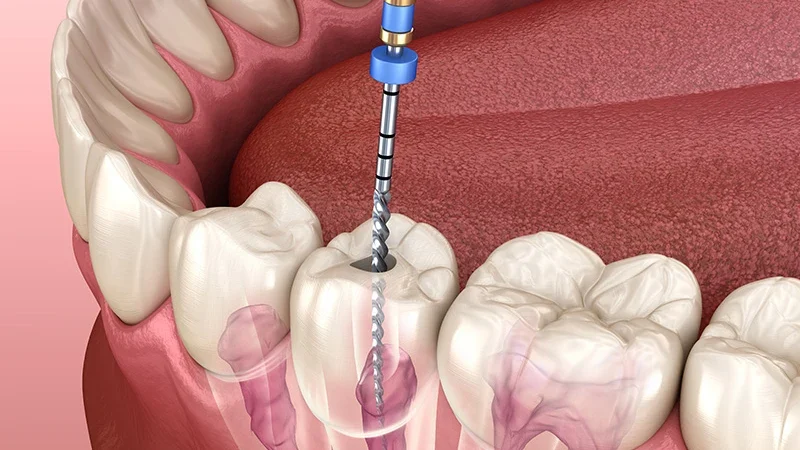
A root-treated front tooth does not automatically need a crown. The choice depends on sound remaining tissue, existing restorations, cracks and the colour change wanted. A crown may protect an extensively damaged tooth, while a direct restoration or suitable internal whitening may be more conservative in another case. The assessment should separate appearance from structural need.
Separate discolouration from structural weakness
An endodontically treated incisor may become darker because of changes within the tooth or old restorative materials. Discolouration does not necessarily mean the tooth is fragile enough to need a crown. Conversely, a tooth that looks reasonably white may have lost substantial structure through trauma, decay or previous repairs. The dentist should examine the amount of sound tooth above the gum, the position of any cracks and the relationship between upper and lower incisors. A radiograph may help assess the root treatment and surrounding tissues, but cannot by itself show every surface defect.
Consider conservative colour options first
For a tooth with an acceptable outline and sufficient structure, internal bleaching may sometimes improve intrinsic discolouration under suitable professional supervision. External whitening affects natural teeth but not the colour of existing porcelain or composite. A new composite restoration may also be considered if the main issue is an old discoloured filling. These approaches have limits, especially with deep darkening or extensive prior damage. The dentist should discuss which colour mechanism is involved before offering a crown simply because a single tooth looks noticeably darker than its neighbour.
When a crown becomes the rational choice
A crown may be appropriate if a tooth has a large restoration, important missing edges or needs more complete reshaping. The dentist checks how much sound tooth remains around it and where a reliable crown edge can sit. If most of the visible tooth has been rebuilt, a core build-up or post may need consideration. A post helps retain a build-up in selected teeth; it does not generally strengthen the root. Your plan should explain the alternatives or any referral needed.
Selecting the ceramic is about light as well as strength
Lithium disilicate and zirconia handle light and forces differently. Translucent ceramic may blend well over a light tooth yet show unwanted darkness over a discoloured foundation. More opacity can improve masking but needs careful shape and texture to avoid a flat appearance. Records of the prepared tooth shade, photographs, cement choice and laboratory communication help the plan. One shade code cannot describe all these features.
A single central incisor is a demanding aesthetic task
Two central incisors are usually viewed together, making differences in width, gum level, surface texture and light reflection easy to notice. A successful restoration should be assessed in a relaxed smile, broad smile and ordinary speech. The patient can ask for a temporary or trial shape if the case permits, and should know how changes are agreed with the laboratory. The dentist should also check bite contacts so that adjustments made for appearance do not create an unhelpful incisal loading pattern.
Request a tooth-preservation explanation
Before a crown, understand the additional preparation, the condition of the root treatment and whether a veneer or direct repair could meet the goal with less alteration. The estimate should include any core build-up, temporary crown, laboratory work and reviews. Maintenance and changes in prognosis remain possible. The decision should balance the appearance improvement with the tissue and function being preserved.
References and further reading
Book an assessment
The practices are in Hatfield and Cheshunt in Hertfordshire, and Friern Barnet in North London. For travel from Bedfordshire, Buckinghamshire or Essex, confirm the actual practice and any sites involved in later stages.
Editorially updated: 27 October 2026.
Your next step, when you’re ready
We would be pleased to welcome you for a £30 consultation at your preferred Iconic Smiles practice. Bring your questions, and we can talk through the options that may suit you.
Any additional investigations and their fees will be explained before you decide.