
Repairing your teeth
Protecting a Root-Filled Molar: Filling, Onlay or Crown?
A molar that has undergone root canal treatment may have lost substantial tooth structure from the original decay, older fillings or an access cavity.
Talk through your options for repairing teeth
If you would like to understand how a tooth might be repaired or protected, a £30 consultation offers time to discuss your concerns and what an individual assessment may involve.
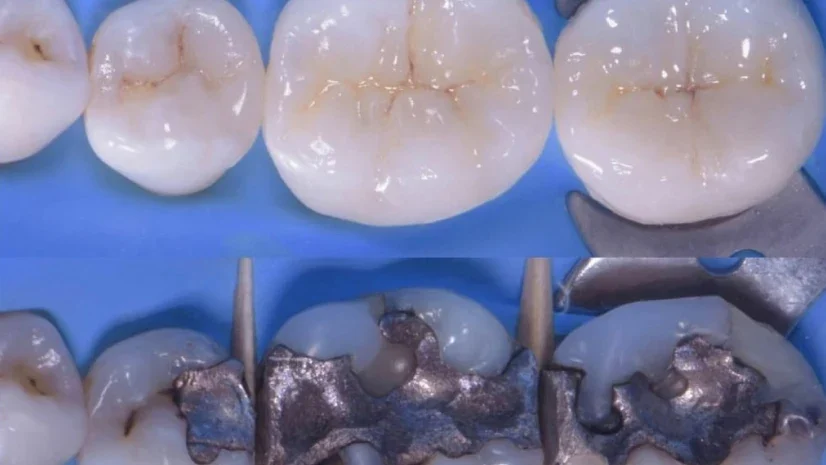
A root-filled molar may need a filling, onlay or crown, depending on the sound tooth remaining and the forces it carries. Root canal treatment alone does not automatically make a crown necessary. Decay, previous fillings and the access opening can leave weakened cusps. The restoration should protect those at risk while preserving healthy tissue where possible.
Separate endodontic success from structural strength
A satisfactory root filling treats the canals but cannot replace missing tooth walls or remove the risk of cracks. The dentist checks the ridges at the sides of the chewing surface, cusp thickness, remaining dentine and filling edges. A cavity extending across the chewing surface and both adjoining sides, often called MOD, can leave cusps poorly supported. Appropriate X-rays help assess roots and surrounding tissues but do not reveal every crack. Protection may be needed even without current pain.
When a direct filling might suffice
A comparatively small access cavity in a tooth with strong marginal ridges may sometimes be restored conservatively with a suitable adhesive filling. Isolation, contact shape and bite clearance influence the quality of that repair. A larger missing cusp or extensive undermining can make direct composite less predictable under molar chewing forces. Ask the dentist to explain why a small repair is sufficient or why the remaining tooth needs cuspal coverage rather than merely being told that all root-filled teeth must receive crowns.
Onlays preserve selected surfaces
An indirect onlay can cover weakened cusps while retaining healthy walls that do not require removal. Ceramic and indirect composite alternatives have different preparation and bonding requirements. The dentist must ensure sufficient material thickness and sound margins, and must account for the behaviour of the opposing tooth. Retaining a cusp with a deep crack or inadequate support simply to minimise preparation can be counterproductive. The aim is selective protection of the parts most at risk.
When full coverage is reasonable
A crown may be appropriate when several cusps are weakened, old restorations limit retention or partial coverage cannot provide a suitable contour. Remaining structure includes the band of sound tooth a crown can encircle, known as the ferrule. A post may help retain a core in selected cases; it does not make a weak root stronger. Establish how findings after an old restoration is removed could change the outlook or design.
Plan the complete restorative sequence
The root-treated tooth may need a period of review or definitive core preparation before the chosen restoration is fabricated. The clinician should assess gum health, contact with adjacent teeth and the bite, particularly where there is grinding or an opposing crown. An itemised treatment plan should differentiate endodontic care, post and core if needed, provisional work and the final onlay or crown. A well-designed restoration makes chewing comfortable and allows the tooth to be cleaned and monitored over time.
A root-filled tooth is not one clinical category
A small access opening with intact side ridges and no cracks can offer more conservative options than a molar largely occupied by an old filling. The latter may need cusp protection even if both root treatments are satisfactory. Removing the filling could reveal a deeper crack and change the plan. The written explanation should identify what needs protection now, what can be observed and why a filling, onlay or crown has been selected. Include any temporary stage and its cost.
Your next step, when you’re ready
We would be pleased to welcome you for a £30 consultation at your preferred Iconic Smiles practice. Bring your questions, and we can talk through the options that may suit you.
Any additional investigations and their fees will be explained before you decide.