
Bonding, veneers and whitening
Restoring Widespread Tooth Wear Without Crowning Every Tooth
Patients with worn teeth sometimes assume that a full set of crowns is the only way to rebuild their bite and smile.
Discover what could suit your smile
Whether you are thinking about colour, shape or a subtle change, a £30 consultation is a welcoming place to share your ideas, ask questions and explore a personalised approach.
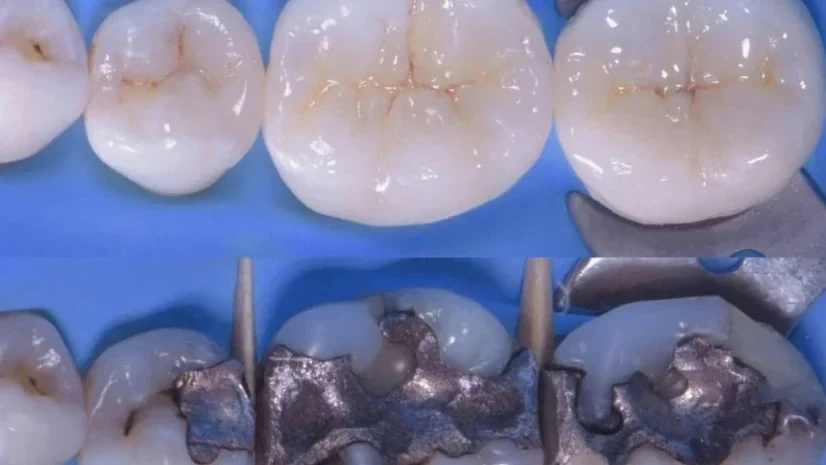
Widespread tooth wear can sometimes be restored with selected additions rather than crowns on every tooth. Suitability depends on the cause of wear, remaining enamel and dentine, and space for material. Acid erosion, abrasion and tooth-to-tooth wear can act together. The plan needs to address those causes so the new work is not left facing the same avoidable forces or acid exposure.
Map the pattern before choosing materials
The clinician examines which surfaces are affected, the extent of dentine exposure, bite contacts, existing fillings and the patient's history of diet, reflux, clenching or other relevant factors. Photographs and scans can document the current tooth form, but repeated records and clinical context help decide whether wear is progressing. Upper front edges with erosive palatal wear need different design decisions from heavily worn lower molar chewing surfaces.
Additive composite may conserve tissue
With enough remaining structure and bite space, composite can rebuild selected contours with little or no extra tooth removal. Small chips can often be repaired locally, although staining, wear and later maintenance remain possible. Several additions used to rebuild a bite need coordinated contacts and sometimes staged adjustment. Preserving tissue does not remove the need for careful functional planning.
When ceramic or crowns become reasonable
Ceramic onlays, veneers or crowns may be discussed when larger restorations, material properties or remaining tooth structure make them suitable. A full crown generally involves greater circumferential preparation than many additive or partial-coverage alternatives. The clinician should explain why a particular tooth needs that level of coverage, rather than using the same restoration on every tooth for visual uniformity. Existing root treatments and cracks may change the calculation for individual teeth.
Test the proposed bite before definitive work
Diagnostic models, digital articulation and provisional additions can help evaluate tooth length, speech and contact patterns. The dentist should assess vertical dimension carefully because increasing the height of multiple teeth can change facial appearance and chewing adaptation. Not every worn bite needs a large increase, and a trial that feels comfortable for a few minutes does not prove long-term function. Staged treatment can make adjustments and learning possible before irreversible preparation.
Maintenance is part of the makeover
Managing the underlying wear process may include dietary advice, reflux assessment, protective splints where indicated and ongoing review. Restorations do not remove the need to protect enamel that remains. Ask which teeth can be left alone, where limited additions will work and what repair costs may arise later. A conservative full-mouth plan is often more sophisticated than crowning an entire arch simply because the smile looks short.
When preserving enamel changes the whole rehabilitation
Someone in their forties with flattened front edges and shallow cups in molar surfaces may assume crowns are necessary. Examination might instead find enough enamel for selected composite additions, alongside assessment of acid exposure, grinding, saliva and diet. The dentist needs a reproducible bite record and enough room for the additions without excessive removal. Digital models and a trial build-up may help assess the appearance and function.
Heavily crowned teeth with fractured remaining structure may need a different plan, with selected onlays or crowns where additions lack predictable support. The choice follows usable tooth structure and the intended distribution of forces. A tooth-by-tooth plan can show what remains, what will be added, which work is temporary and the likely repair commitment. Stages can help avoid irreversible preparation of sound teeth for uniformity alone.
Restoring worn front teeth with an additive approach
Additive treatment builds up what has been lost
An additive composite approach rebuilds selected worn surfaces with resin. It can be considered for some cases of localised anterior tooth wear, with the aim of restoring shape while limiting further removal of tooth tissue. ‘Additive’ describes the approach; it does not establish that every worn tooth can be treated without preparation or that crowns are never needed. [1]
Establish whether the wear is still progressing
The assessment should consider the pattern of wear, symptoms and possible chemical and mechanical contributors. UK preventive guidance discusses acid exposure, diet, medical factors and mechanical wear. Restoring the edges without addressing an active cause can leave the underlying problem unresolved. A prevention plan and suitable records for future comparison belong alongside the proposed reconstruction. [2]
Where will the new material fit?
The space between upper and lower teeth influences where new material can fit. A Dahl approach uses a deliberately planned change in contacts for selected localised wear, with adaptation monitored over time. It is more than adding length until edges look level. Establish how your bite would change and what alternative is planned if the intended adaptation does not occur. [1]
What the review actually tells us
The systematic review included six studies and 141 patients receiving 1,068 restorations. Follow-up and results varied substantially. The authors regarded anterior composite as a short- to medium-term option for localised wear and stressed monitoring, repair or replacement over time. These findings do not establish equivalent results for every full-mouth reconstruction or a guaranteed repair-free period. [1]
Compare preservation and the maintenance commitment
Ask which teeth need building up, whether treatment is staged, how the proposed shape will be assessed and what maintenance is likely to involve. Rebuilding severely worn teeth may need a broader plan where several areas of the bite are affected. An understandable estimate should distinguish the initial reconstruction from later review, polishing and possible repair.
Research and guidance
Your next step, when you’re ready
We would be pleased to welcome you for a £30 consultation at your preferred Iconic Smiles practice. Bring your questions, and we can talk through the options that may suit you.
Any additional investigations and their fees will be explained before you decide.