
Dental implants — replacing missing teeth
A front-tooth implant assessment: planning the tooth and gum line
A missing front tooth can affect appearance, speech and confidence, but the assessment still needs a diagnosis and appropriate replacement options.
Explore your tooth replacement options
If you are considering replacing a tooth or several teeth, a £30 consultation gives you a chance to explain what matters most, ask questions and explore the options with our team.
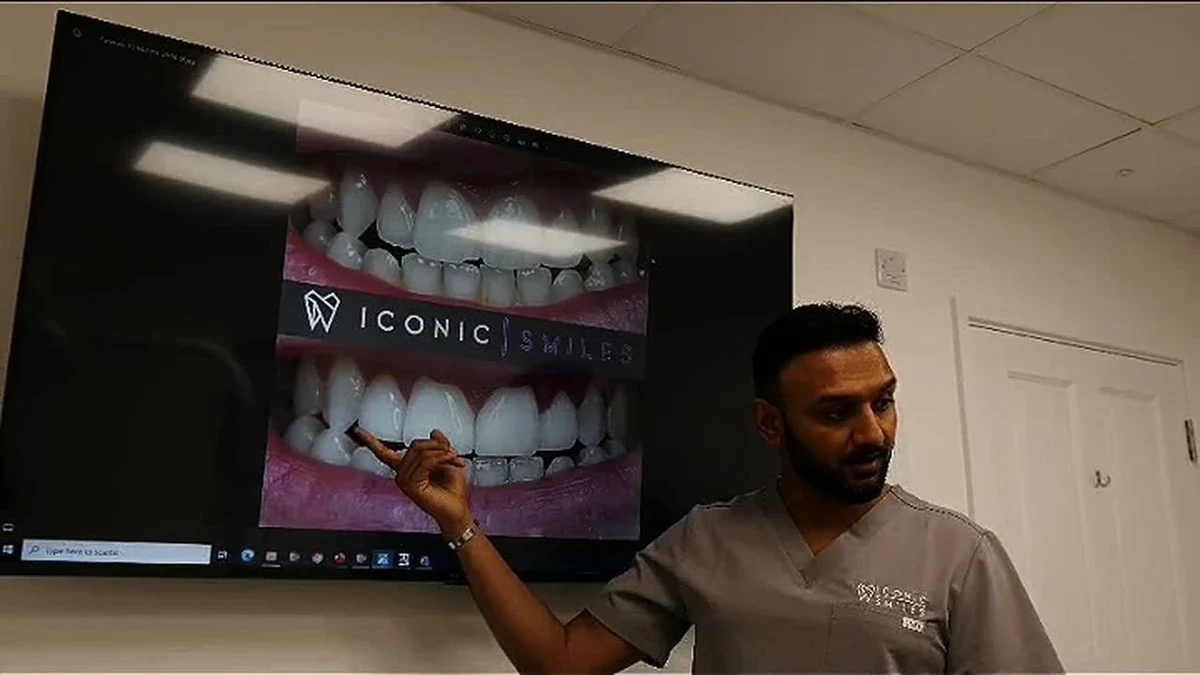
Define the visible result and the health decision separately
A front-tooth implant needs to be planned with the gum line and neighbouring teeth, because all three influence how your smile will look. If the natural tooth is still present, the first question is whether it can reasonably be kept. Your assessment should explain the diagnosis, preservation options and suitable replacements before any decision about extraction.
The gum line is part of the appearance
An implant crown does not create the whole visible result by itself. ITI aesthetic guidance considers the position of the implant and the surrounding tissues as well as the restoration. Ask what will be visible when you smile and which features can reasonably be achieved. A crown may match the adjacent teeth in colour while another tissue or positional limitation remains important. The assessment should make those issues understandable rather than leave the patient to infer the final gum appearance from a tooth-shaped preview. [1]
Position needs to serve the intended crown
The fixture is placed in bone and supports a separate visible restoration. Appropriate assessment and investigations relate the site to that restoration. Ask how the planned crown influences position and what the available tissues permit. A visible gap or a surface model cannot establish every condition beneath the gum. Digital planning can support the discussion, but the clinician should explain what has actually been assessed and which findings could require a different position, an additional stage or another treatment option. [2][1]
Tissue preparation may affect the pathway
Bone grafting can be proposed when additional bone is needed for an implant plan. The 2023 ITI consensus also considers bone dimensions and selected soft-tissue augmentation outcomes. These findings do not establish that every front-tooth case needs a graft or that a procedure guarantees a particular appearance. Ask what the proposed stage is intended to improve, its important risks and the limitation that might remain. The discussion should connect the tissue procedure to the crown and patient goal, with the extra recovery and cost made clear. [3][4]
A temporary tooth and immediate loading need their own explanation
Clarify how the space will be managed during assessment, healing and restorative treatment. A temporary replacement may be a separate arrangement from the definitive crown. ITI guidance distinguishes placement from loading and recommends alternatives when preferred clinical conditions are not achieved. Ask which sequence is intended and what would change it. A front-tooth appearance concern can make interim arrangements particularly important, but it does not replace the clinical judgement about whether an implant can appropriately support an early restoration. [5]
Compare the alternatives and complete intervention
An implant may avoid preparing neighbouring teeth in some situations, while a bridge, removable replacement or another option may also be reasonable. Ask how each approach affects the supporting structures, appearance, function and ongoing care. If the proposal changes adjacent teeth for colour or symmetry, request the reason for that additional work. The appropriate plan should meet the diagnosed need and the patient’s priorities without assuming every healthy neighbouring tooth must be altered to make the replacement easier to match. [2]
Agree the design, review and practical responsibilities
Request the intended crown, tissue-related stages, temporary care, important risks, full estimate and maintenance plan. The EFP guideline recommends prevention throughout the implant pathway and supportive assessment after restoration. At Iconic Smiles, identify the clinicians and locations for the surgical, restorative and review stages. A useful front-tooth assessment leaves the patient understanding both the visible ambition and the clinical conditions it depends on, with realistic limits and a clear alternative if the preferred route cannot provide an acceptable result. [6][7][8]
What matters here:
Your plan should show how the crown and surrounding gum will work together, what you would wear while healing and any limits to the expected appearance.
Make the decision around your priorities and the clinical limits
You may place different weight on avoiding surgery, preserving adjacent teeth, having a removable appliance, the number of stages or the financial commitment. Those preferences deserve a discussion alongside clinical suitability. Request the likely benefits and important risks of each realistic choice, including the consequences of delaying treatment. There is no obligation to accept a plan because it uses the most technologically advanced component. A well-supported decision is one you can explain in your own words: what it addresses, why it suits your circumstances, how it will be maintained and what compromises you accept.
Understand position before discussing correction
Planning the implant position is essential: later changes to the visible crown cannot solve every position or gum-related limitation. Guided methods may help reproduce a planned position more accurately. An overview of research found greater placement accuracy, while important clinical results were similar in the included evidence. Guidance can help deliver a plan, but cannot guarantee freedom from appearance, tissue or mechanical problems. Supporting source (academy.iti.org)Read the supporting clinical study (2)
Treat the definitive crown as a clinical stage
Before the final crown is accepted, the discussion should cover the intended appearance, bite, practical cleaning and any acknowledged limitation. Ask how the temporary stage has informed the final plan and what further adjustment is realistically possible. The implant, connecting components and visible crown have different functions, and a change to one may not solve a concern arising elsewhere. Clear explanations help you distinguish an adjustment from an additional procedure. If expectations have changed, raise them before final completion rather than assume that an unspoken concern will resolve after fitting. Supporting source (academy.iti.org)NHS patient information
Make cleaning access part of the handover
Before choosing an implant crown, understand how you would clean the tooth and the area where it meets the gum. The team should demonstrate aids that suit the space and what you can manage. If access is uncomfortable or impractical during your care, they need to assess the cause rather than leave you to force an aid through or stop cleaning. EFP guidance recommends prevention throughout treatment and regular care afterwards. Read the supporting clinical study
Why front and back implants have different priorities
A molar must function under chewing loads, allow floss or interdental cleaning and fit the opposing bite. Its shade usually matters less than its contact points and contour. A front incisor has demanding aesthetic, speech and lip-support requirements, while still needing functional clearance during jaw movements. The type of ceramic, screw-access position and abutment design may therefore differ by site. No single product material is ideal for every tooth. Ask how the planned crown will balance appearance, maintenance and strength where it will actually be used.
Not all temporary teeth attach to the implant
Depending on the anatomy and timing, a provisional replacement might be a small removable denture, a resin-bonded bridge or a crown connected to the implant. The choice depends on stability, surgical timing, existing bone and how much load the site can tolerate. An implant placed into a fresh socket does not automatically mean the patient is suitable for immediate functional loading. In some situations keeping pressure away from the healing implant is more important than using the fixture to hold the temporary tooth. The clinician should explain exactly what is supporting the provisional restoration.
Understand why tissue-related stages may change the schedule
Some sites need additional bone or soft-tissue management. The purpose, alternatives and implications of that intervention should be clear. NHS information describes bone grafting as a possible stage in implant care, while the aesthetic consensus emphasises the relationship between implant position and surrounding tissues. A staged plan is not automatically inferior to a faster route. The important question is what the proposed timing is intended to achieve in your site, which uncertainties remain and how healing will be assessed before the next intervention. Avoid borrowing another patient’s timetable as your own. NHS patient informationSupporting source (academy.iti.org)
Compare solutions to the same diagnosed problem
An implant, bridge or removable tooth may each be suitable for a front-tooth gap; the best fit depends on your gums, neighbouring teeth and priorities. NHS information also includes leaving a space in selected circumstances after discussing the consequences. Your assessment should distinguish a temporary gap from the need for a long-term replacement, including any tissue loss or adjacent damage that affects the options. NHS patient information
Compare acceptable outcomes rather than ideal pictures
Your consent discussion should cover the likely benefits, material risks, alternatives and the possibility that expectations cannot be met fully. Consider how a bridge, removable replacement or another appropriate option would affect adjacent teeth, appearance and maintenance. At Iconic Smiles, request a documented explanation of any additional work proposed for neighbouring teeth and the complete estimate. Photographs can help explain an ambition, but another patient’s result does not establish your outcome. A decision is better informed when you understand which features are controllable, which depend on healing and what further treatment might involve. NHS patient informationSee our current treatment fees
Compare the complete period without a definitive tooth
An implant plan may involve extraction, healing, grafting where indicated, placement and restoration. An immediate-placement proposal does not by itself promise a final crown that day. Ask what temporary arrangement applies to each alternative and what you will be able to manage during treatment. For a patient who speaks frequently at work or travels, the interim stage may be a significant practical consideration. The clinician should explain which constraints are inherent to the proposed treatment and which can be adapted, including the fallback if the preferred implant timing is unsuitable. NHS patient informationSupporting source (academy.iti.org)
Matching colour takes more than a shade code
Teeth are not uniformly white. They have varying translucency, warmer areas near the gum, lighter incisal edges and surface textures that scatter light. A laboratory can use photographs with appropriate shade references to build these effects into ceramic. For an implant crown the underlying abutment material and ceramic thickness can also affect appearance. Choosing a highly opaque crown may hide underlying metal or shadowing yet look flat if the surrounding teeth are translucent. A try-in and careful comparison in normal lighting help the team discuss the result. Whitening the surrounding teeth first may be worth considering because ceramic colour will not bleach later.
Keep immediate treatment promises conditional
An immediate implant and an early temporary tooth describe different decisions: when the implant is placed and when a restoration is connected. The ITI guidance considers patient selection, tissue conditions and stability when selecting placement and loading protocols. For a visible front-tooth gap, the practical question is also what you will wear if the preferred early-restoration plan cannot proceed. Discuss that alternative before surgery. A temporary tooth should have a clear purpose and care instructions, rather than be assumed to have the same role or durability as the definitive crown. Supporting source (academy.iti.org)
Know when the situation needs urgent help
Contact a dentist urgently for a suspected dental infection, particularly with increasing pain or swelling. NHS advice directs patients to emergency care for serious features such as difficulty breathing, speaking or swallowing, substantial mouth swelling or eye involvement. These instructions apply to the symptoms, not to whether the visible crown still looks intact. At Iconic Smiles, confirm the normal and out-of-hours contact arrangements and which location handles a review. Good aftercare combines an achievable daily routine with an appropriate response to change; it cannot guarantee that no biological or mechanical problem will ever develop. NHS patient informationFind an Iconic Smiles practice
The emergence profile is part of smile design
A suitable temporary crown can help shape and support the gum as it heals. Too much bulk may put pressure on the tissue; too little may leave an appearance or cleaning difficulty. Your dentist may adjust the shape gradually, particularly for an upper front tooth beside a natural tooth. This can help guide the gum contour, including the small triangle of gum between teeth, but it cannot replace missing bone.
The laboratory and the restoring dentist need the same target
Digital scans, photographs and information from the provisional shape can help communicate the intended crown to the technician. The final ceramic must still account for the colour of the surrounding enamel, the shade of any underlying component and the actual gum contour at the time of restoration. Patients may be invited to assess tooth length and surface character before definitive manufacture. A transparent consultation should clarify whether multiple temporary adjustments are included and how changes to the tissue may alter the quoted timetable.
Report tissue changes without diagnosing them yourself
Persistent or new bleeding, swelling, pus or a recurring unpleasant taste merits professional assessment. Peri-implant mucositis affects the soft tissues; peri-implantitis also involves loss of supporting bone. A patient cannot determine the diagnosis or its extent from the appearance of a blood spot. Equally, the crown looking attractive does not rule out a tissue problem. Explain when the change started, whether it recurs and whether there are other symptoms. Seek advice earlier than a routine maintenance visit if a concern develops, following the service’s contact arrangements. Periodontology guidanceRead the supporting clinical study (2)
The gumline creates the visual frame
Natural teeth emerge through a scalloped gum contour, with papillae filling spaces between neighbours. The contour around an implant is influenced by bone and soft-tissue thickness, existing gum shape and the position of adjacent teeth. A person with a high smile line may notice tiny asymmetries that would not show when smiling more narrowly. Soft-tissue grafting or a carefully shaped provisional restoration may be appropriate in selected cases, but neither guarantees perfect symmetry. The dentist should explain what can realistically be maintained or altered before surgery, especially after a long-standing gap.
Begin with the intended replacement and the existing tooth
The starting question is whether the tooth needs replacement and, if so, what a satisfactory replacement requires. Assessment should consider the diagnosis, neighbouring teeth, available tissues, bite and the intended position of the new crown. If the tooth is still present, ask why it cannot reasonably be retained and which alternatives have been considered. A visible gap can make speed feel like the only priority, but the plan needs to address the future restoration as well as the extraction appointment. Necessary preparatory treatment should be explained before an irreversible step. NHS patient informationSupporting source (academy.iti.org)
Ask what each option asks of neighbouring teeth
An implant obtains support from an implant within the bone, while a tooth-supported bridge uses natural teeth for support. Bridge designs differ, and some need preparation of neighbouring teeth. An intact tooth and a heavily repaired tooth create different choices. Your dentist should explain the effect on each supporting tooth, what a future complication could mean and how the complete replacement would be maintained. NHS patient information
What a realistic consultation should demonstrate
Ask to see examples of how the clinician evaluates smile line, gum proportions and adjacent tooth colour. Have them explain the implant position, whether grafting is proposed, how the laboratory will communicate shade and when the definitive crown will be fitted. Request a frank discussion of limitations rather than a promise of an invisible result for everyone. The final goal is a natural-looking tooth that also bites comfortably, cleans well and can be maintained. A beautiful crown that is awkward to floss or over-contoured at the gum is not a balanced outcome.
Distinguish appearance concerns from a technical change
Before treatment, know how to contact the team if the shade match, gum line, bite or fit changes during your care. Implant components can loosen or wear, and an examination is needed to identify the cause. Do not test a moving crown by biting harder, tighten it yourself or use household adhesive. Contact the treating service for instructions; a photograph can help describe a change but cannot replace assessment of movement, discomfort or inflammation. NHS patient information
Research and guidance
- Esthetics in Implant Dentistry - Consensus Statements - ITI ITI â International Team for Implantology
- Dental implants - Overview | Guy's and St Thomas' NHS Foundation Trust
- Bone grafting for dental implants - Overview | Guy's and St Thomas' NHS Foundation Trust
- Group 1 ITI Consensus Report: The role of bone dimensions and soft tissue augmentation procedures on the stability of clinical, radiographic, and patient-reported outcomes of implant treatment.
- Implant Placement and Loading Protocols - Consensus Statements - ITI ITI â International Team for Implantology
- Prevention and treatment of peri-implant diseases-The EFP S3 level clinical practice guideline.
- Dental Team | Meet the Iconic Smiles Clinicians
- Dental Practices in Hertfordshire & London | Iconic Smiles
Your next step, when you’re ready
We would be pleased to welcome you for a £30 consultation at your preferred Iconic Smiles practice. Bring your questions, and we can talk through the options that may suit you.
Any additional investigations and their fees will be explained before you decide.