
Dental implants — replacing missing teeth
Why an implant assessment starts with the final crown
A dental implant is just one part of replacing a tooth. Discover why planning the crown, gumline and bite together matters before treatment begins.
Explore your tooth replacement options
If you are considering replacing a tooth or several teeth, a £30 consultation gives you a chance to explain what matters most, ask questions and explore the options with our team.
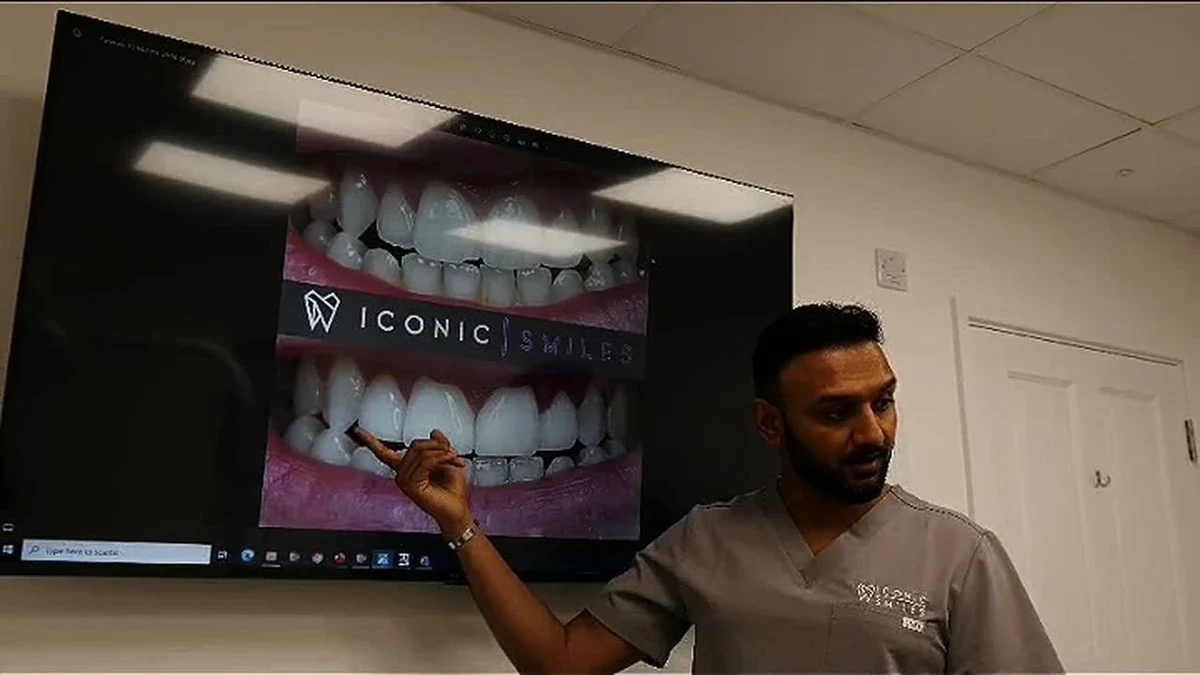
Plan your new tooth before the implant
An implant assessment starts with the tooth you need, because the position of the implant affects how that tooth will look, bite and be cleaned. The implant sits in bone; the crown provides the visible replacement. Planning them together helps establish whether the proposed position can support a suitable crown before surgery. [1]
Define what the replacement needs to do
A front tooth may place particular demands on appearance, while any replacement also needs an appropriate relationship with the opposing teeth and access for care. ITI aesthetic consensus guidance considers implant position and the surrounding tissues as part of the restorative outcome. The visible crown should be discussed alongside those conditions rather than designed as an isolated shape. Explain what concerns you about the missing tooth and ask which features of the intended replacement are achievable, uncertain or dependent on preparatory care. [2]
What lies beneath the gum matters too
A gap may look wide enough for a crown while the conditions beneath the gum still need checking. Examination and appropriate imaging show the site, neighbouring teeth and nearby anatomy. Your dentist should explain any remaining uncertainty and how further information could change the plan. [1]
Understand why bone and gum conditions affect the sequence
The implant assessment may identify a need for additional tissue-related treatment. NHS information on bone grafting describes augmentation as a possible stage where the available bone is insufficient for the proposed approach. Ask why it is being recommended and how it serves the final replacement. Grafting is not an automatic requirement for every implant patient, and the possibility of placing a fixture does not automatically establish that the desired crown and tissue appearance can be achieved without further planning. [3][2]
Check the role of temporary teeth
A temporary replacement and the definitive crown have different purposes within a staged pathway. Ask how the visible space will be managed during assessment and healing, and which temporary option fits the surgical and restorative plan. A same-day replacement is a separate loading decision requiring suitable clinical conditions, not proof that the final restoration is complete. The written sequence should identify the temporary and final stages and explain the alternative if the preferred early-loading conditions are not achieved. [1][4]
Keep future cleaning and review in the design discussion
Peri-implant prevention begins during planning and continues through surgery, restoration and supportive care. Ask how the proposed crown and surrounding tissues will be accessed for cleaning and professional assessment. A replacement that looks convincing on the fitting day still needs maintenance. The EFP guideline recommends a structured programme after implants are restored, so the discussion should include who reviews tissue health, how you report a concern and what an adjustment or repair might involve later. [5]
Compare the complete options before committing
Ask whether an implant, a bridge, a removable replacement or another reasonable approach best meets the diagnosed need and your priorities. Request the planned crown, any preparatory work, important risks, expected stages and full estimate. At Iconic Smiles, confirm which clinicians and locations will provide those stages. A clear assessment lets you understand why the final replacement guides the surgery and what would make the proposed pathway change; it does not need to promise that every preferred shape or timetable can be guaranteed. [1][6][7]
What matters here:
The implant position and crown design need to work together. If the desired tooth cannot be supported appropriately, you should understand the alternatives before surgery.
The difficulty may concern the tooth, the site or both
An implant plan has to connect the fixture in bone with a useful replacement tooth. If the preferred position is difficult, the clinician should explain what limits it: the available tissues, neighbouring structures, the intended crown or a combination. The description should be specific enough that you understand the consequence. Being able to insert a fixture somewhere is a different question from whether that position supports the appearance, function and future care being proposed for the crown. [source][source]
Start by agreeing what the replacement should achieve
An implant pathway begins with the replacement tooth or teeth the treatment is intended to provide. Discuss function, appearance and the reasonable alternatives before deciding on the surgical route. The NHS distinguishes the fixture from the crown, bridge or denture it supports. That distinction helps you understand why planning cannot end with the statement that an implant can be placed. Ask what the final restoration is expected to do and which conditions must be established to support it. [source]
Choose between explained trade-offs
Compare the benefits, procedures, irreversible changes, important risks, visits and total cost of the realistic options. Explain which outcomes and commitments matter most to you. Before deciding, understand the temporary teeth and the alternative if a stage cannot go ahead. Changing the plan can be the sensible response to a limitation.
Further clinical details: Plan the Implant Crown Before Placing the Implant: Why Position Matters
The replacement crown should be planned before the implant is placed. Its intended position helps the team decide where an implant can safely support it, rather than simply choosing the area with the most bone. Otherwise, the finished crown may be bulky, difficult to clean or awkward in the bite. This is especially important for a front tooth or when neighbouring implants replace a short span of teeth.
Start with the proposed tooth, not the drill
The dentist can use a study model, digital scan, diagnostic wax-up or provisional mock-up to define the expected tooth length, width, gumline and biting edge. That design indicates where the crown will emerge through the gum and how it should meet opposing teeth. It also exposes compromises early: an attractive tooth shape may need more space than the present gap allows, or the desired gum level may be difficult to reproduce without additional soft-tissue treatment.
Three-dimensional position has consequences
Position matters in three directions: depth, distance from neighbouring teeth and position towards the lip or tongue. Adjacent roots and nearby anatomy limit where the implant can go. An implant too close to the lip side may be difficult to cover without a bulky crown. One too far towards the palate or tongue can make fitting components and cleaning more difficult. These choices affect the design from the outset; they cannot all be corrected when the crown is fitted.
How digital records are used
A surface scan records teeth and accessible gum contours, while X-ray imaging shows relevant bone and anatomy. Where a three-dimensional CBCT scan is justified, the team can combine these records to compare a proposed implant path with the planned crown. Software helps the dentist, surgeon and laboratory share the design. During treatment, they still need to check the surgical guide's fit, access to the site and any findings that differ from the scans.
When orthodontics should come first
If adjacent teeth have drifted or tipped into a gap, simply squeezing in a crown can create a narrow, difficult-to-clean restoration. Orthodontic movement may recover appropriate crown width and reposition roots. This takes planning between the orthodontic and restorative clinicians: the apparent gap between visible crowns may be wider than the safe space between roots. The implant itself will not move orthodontically after integration, so the order of treatment matters.
Why a surgical guide is not the whole plan
A printed or fabricated guide transfers a proposed position into surgery, subject to manufacturing accuracy and fit. It cannot ensure that the proposed prosthesis is attractive or maintainable unless those choices were made beforehand. The 2023 ITI consensus on implant placement emphasises restoratively driven three-dimensional positioning and advance planning for provisional and alternative restorations in appropriate immediate-placement protocols.
Questions worth bringing to consultation
Ask to see the future crown shape, expected gum contour and how you will clean around the result. Clarify whether the plan assumes a screw-retained or cemented crown, whether a temporary tooth is needed, and what happens if bone conditions differ from those anticipated. Choosing an implant team should involve confidence in both the surgery and the final tooth design. Those are inseparable parts of a successful replacement.
The laboratory handover that makes the difference
Consider an upper premolar gap that is wide at gum level but narrower between the visible teeth. An implant centred on the ridge without considering the crown could leave the replacement angled sharply to meet the opposing tooth. Planning the chewing surface and tooth contacts first helps the team agree a suitable implant path. If the tooth shows when you smile, the gum edge and contour towards the cheek matter too. The plan should allow space for interdental cleaning and a sensible position for a screw-access channel. A printed or digital view of the implant beneath the proposed crown can make these relationships easier to understand. If it reveals a compromise, orthodontics, grafting or a bridge can be discussed before surgery.
Understand the practical role of a removable replacement
A removable prosthesis may be an appropriate temporary or definitive option, depending on the findings and your preferences. Discuss comfort, stability, appearance, cleaning and the ability to adapt to it. If it is temporary, clarify how it fits the later treatment stages and whether modification or replacement would be needed. If it is intended for longer-term use, ask how it will be reviewed. Comparing it with a fixed option requires the complete maintenance and functional picture, not simply the fact that one can be removed. NHS patient information
Additional treatment introduces its own trade-offs
Bone grafting or other preparatory stages may be proposed to improve the site. Ask what each is intended to change, what it cannot establish and how it affects the sequence, recovery and cost. NHS information describes bone grafting as a possible addition rather than a requirement for every implant. A more extensive surgical route may be appropriate in a particular case, but it needs comparison with the reasonable alternatives and the benefit the patient actually values. NHS patient information
Assessment checks the site and the wider clinical picture
The team takes a medical and dental history, examines the mouth and obtains appropriate records. Explain medicines, smoking, previous problems and the priorities that affect your choice. Ask which findings are established and whether more information is needed before the sequence can be confirmed. A responsible plan can distinguish a likely route from a conditional stage. It should not present every later decision as settled if the condition of the site or an existing tooth still needs clarification. NHS patient information
Define the limitation before choosing another treatment
If the intended crown would be difficult to provide, your dentist should explain why. The limitation may involve the site, support, desired appearance or a combination. A different implant brand alone will not necessarily solve it. You should understand what each realistic plan could achieve and what compromise would remain. NHS patient information
Compare a revised plan before accepting the compromise
Request an explanation of the preferred option, the expected limitation and the alternative if additional treatment is declined or unsuitable. A bridge, a removable replacement or another appropriate pathway may deserve discussion. Confirm the intended final tooth, temporary care, important risks and complete estimate. You should be able to explain why the proposed compromise is acceptable to you, rather than discover its visible or practical consequences after surgery. If it does not meet your priorities, revisit the plan before an irreversible step. NHS patient information
Compare a bridge through its effect on supporting structures
A bridge is one possible replacement for a gap, with suitability depending on the proposed design and support. Ask which teeth or structures would be involved, whether preparation is required and what future problems could affect the replacement. The NHS implant information lists other tooth-supported approaches among the alternatives discussed with patients. A bridge should not be dismissed simply because it avoids an implant, nor selected without explaining the consequences for the supporting teeth and the wider bite. NHS patient information
Plan the handover into continuing care
An implant that has its final tooth still needs supportive assessment and a cleaning routine you understand. EFP guidance recommends prevention from planning onwards and a structured programme after restoration. Confirm who provides reviews, how a loose or damaged component is reported and what is included in the estimate. At Iconic Smiles, identify the clinicians and locations for the surgical, restorative and maintenance stages. A clear checkpoint plan helps you know what is happening now, what remains conditional and who explains the next choice. Read the supporting clinical study · Meet the Iconic Smiles dental team · Find an Iconic Smiles practice
Consider whether preparatory care changes the options
Bone grafting may be proposed where additional bone is needed for the planned approach. Ask what it is intended to improve, what remains uncertain and how the extra procedure affects recovery, timing and cost. It is not automatically required for every implant patient, and it should not be presented as a universal solution to every appearance concern. The relevant comparison is between complete pathways: a prepared site and intended restoration, a revised restorative plan or another method of replacing the missing tooth. NHS patient information
The healing review determines the next decision
Your plan should include healing reviews after placement. At these visits, the team checks the wound and other findings before moving on to the replacement tooth. Follow the operation-specific instructions and report concerns: feeling comfortable alone does not establish that an implant is ready to carry a tooth. The timing depends on your findings, rather than another patient’s timetable. NHS patient informationNHS patient information
A compromise also needs a maintenance explanation
The proposed design should be considered alongside access for cleaning and professional review. EFP guidance places prevention within planning, surgery, restoration and subsequent supportive care. If the crown or tissue arrangement is expected to make care more demanding, ask what that means in practice and whether another design is reasonable. The goal is not to choose a visually pleasing solution first and leave the cleaning problem for later; the patient should understand the care the intended restoration will require. Read the supporting clinical study
The definitive restoration needs its own appointments and checks
The final crown, bridge or denture needs its own records, fitting stages and checks. The team will discuss appearance, bite and function before completion. If you have temporary teeth, explain what feels comfortable and anything you would like reviewed. Any change to the agreed plan or additional work should be explained before you consent. NHS patient information
Appearance depends on the tissues as well as the crown
ITI aesthetic guidance links three-dimensional implant positioning and supporting tissues with the restorative result. A technically retained crown is not the whole appearance outcome. The visible tooth and the gum around it need discussion together, particularly in an area that shows when you smile. Ask which parts of the desired result can reasonably be achieved and whether any limitation would remain even after additional treatment. A colour match alone cannot answer a problem involving the position or volume of the surrounding tissues. Supporting source (academy.iti.org)
Ask whether changing tooth position is relevant
In selected combined cases, the position of neighbouring natural teeth may be part of the problem. An orthodontic assessment can clarify whether movement would contribute to the restorative goal. An integrated implant remains anchored while natural teeth may be moved, so the sequence needs coordination. Published anchorage reports demonstrate selected possibilities rather than establish that everyone needs orthodontics before an implant. Ask what the movement would achieve and whether its burden is justified for your particular replacement. Read the supporting clinical study · Read the supporting clinical study (2)
Preparatory work should have a stated purpose
Some patients need treatment before placement, including site-related preparation or grafting. Others do not. If a preparatory stage is proposed, ask how it serves the intended restoration and what will be reassessed afterwards. Bone-grafting information explains that augmentation can add to the treatment pathway; the relevant timing depends on the procedure and clinical situation. Confirm temporary tooth arrangements and who will review healing rather than assume that the original surgery date is also the date of the definitive crown. NHS patient informationNHS patient information
Guidance helps deliver a plan; it does not remove its limits
Research finds that guided placement can help an implant finish closer to its planned position. It helps deliver a suitable plan, but cannot make every position feasible or overcome limits from anatomy, tissues, healing or crown design. Your dentist should explain which part of your plan guidance would help. Read the supporting clinical study
Discuss observation where it is a reasonable option
Not every discussion of a missing tooth has to end in the most extensive reconstruction. The NHS includes no treatment among options that may be considered for an individual. Ask what leaving the space would mean for function, appearance and monitoring in your case. This should be a reasoned clinical choice rather than an assumption that all gaps are harmless. If there is active disease or a symptom requiring care, distinguish treating that problem from the separate decision about replacing the tooth. NHS patient information
The visible gap does not describe all the available space
A gap viewed from the front shows where a tooth is missing, but it does not establish the full conditions beneath the gum. Assessment and appropriate imaging help the team relate the site to the intended restoration. Ask what has been measured or observed and what remains uncertain. If adjacent tooth positions contribute to the limitation, the restorative and orthodontic questions may need to be considered together. A digital crown drawn into the space should illustrate a proposal, not replace investigation of whether the supporting plan is appropriate. NHS patient information
Research and guidance
- Dental implants - Overview | Guy's and St Thomas' NHS Foundation Trust
- Esthetics in Implant Dentistry - Consensus Statements - ITI ITI â International Team for Implantology
- Bone grafting for dental implants - Overview | Guy's and St Thomas' NHS Foundation Trust
- Implant Placement and Loading Protocols - Consensus Statements - ITI ITI â International Team for Implantology
- Prevention and treatment of peri-implant diseases-The EFP S3 level clinical practice guideline.
- Dental Team | Meet the Iconic Smiles Clinicians
- Dental Practices in Hertfordshire & London | Iconic Smiles
Your next step, when you’re ready
We would be pleased to welcome you for a £30 consultation at your preferred Iconic Smiles practice. Bring your questions, and we can talk through the options that may suit you.
Any additional investigations and their fees will be explained before you decide.