
Repairing your teeth
Loose Adult Teeth: Why It Happens and Whether They Can Be Saved
A loose permanent tooth needs assessment rather than an assumption that extraction is inevitable.
Talk through your options for repairing teeth
If you would like to understand how a tooth might be repaired or protected, a £30 consultation offers time to discuss your concerns and what an individual assessment may involve.
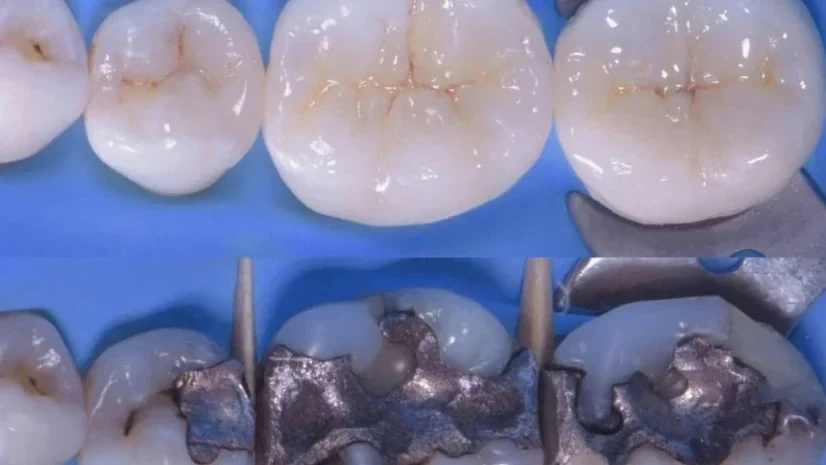
Some loose adult teeth can be saved, while others have too little healthy support or structure to maintain reliably. Assessment establishes why the tooth is moving, including gum disease, injury or excessive bite forces. The treatment and outlook depend on that cause and whether a stable, cleanable result is possible.
Why adult teeth become mobile
Natural teeth have a periodontal ligament and a small degree of physiological movement, but new or increasing mobility can signal disease. Periodontitis reduces supporting tissues; a high bite contact or grinding can aggravate movement; an injury may damage the supporting structures. Different causes require different interventions, and a patient should avoid deliberately wiggling the tooth.
What assessment involves
The examination considers gum inflammation, pocketing, bone support, tooth vitality, cracks, occlusal contact, medical context and timing. Isolated mobility after a knock is not managed exactly like several drifting teeth following years of gum disease. Early assessment is especially important when trauma, increasing mobility or pain is present.
Possible approaches to treatment
Depending on diagnosis, management can include gum disease treatment, stabilising a traumatic contact, protecting an injured tooth or selected splinting. Splinting does not replace treating disease and can complicate cleaning if poorly designed. A structurally unsound or severely unsupported tooth may still require extraction after realistic discussion of options.
Why replacing the tooth immediately is not the only question
If replacement is needed, the remaining teeth, bite, cleaning and gum health influence the choice of a bridge, implant or denture. Where periodontitis caused the looseness, the wider disease still needs control. Replacing a tooth with an implant does not remove the underlying susceptibility to plaque-related inflammation.
What to do before your appointment
Avoid chewing hard food on the tooth and do not attempt to move, tighten or glue it yourself. After an injury, contact urgent dental services promptly; treatment timing can matter. If fever, facial swelling or difficulty swallowing develops, seek urgent medical or dental advice as appropriate.
What a balanced prognosis includes
Before deciding, understand the remaining bone and attachment, whether inflammation can be controlled and how the tooth would function. The clinician should explain the possibility of continuing or recurrent movement, the maintenance needed and the alternatives if retention is unsuitable.
Tooth mobility is a sign, not a single diagnosis
An adult tooth may move because periodontal support has been lost, because a traumatic bite is applying excessive forces, or because injury has damaged supporting tissues. Occasionally an apparent movement originates in a loose crown rather than the whole tooth. These possibilities require different examinations. A dentist may measure mobility, check periodontal pocketing, assess the bite and use appropriate imaging to understand the support remaining around the roots.
Stabilising gum disease and improving cleaning can sometimes reduce inflammation and help retain teeth. Selective bite adjustment or a splint may be considered in an appropriate case, but connecting teeth without treating active disease does not remove its cause. A tooth with a vertical root fracture, severe unreconstructable damage or very poor support may not be maintainable. Prognosis depends on the combination of findings and the patient's ability to attend ongoing care.
Do not repeatedly push a loose tooth to see how much it moves. Arrange assessment, especially if there is worsening pain, swelling or a history of trauma, and ask the clinician to explain both retention and replacement options before agreeing to extraction.
Work out whether movement comes from the tooth or the restoration
A loose crown can feel like a loose tooth even when the root remains stable. Conversely, a tooth with a sound crown can move because of periodontal support loss. The examination may involve checking crown margins, tapping or gently assessing mobility, periodontal measurements and appropriate radiographs. Injury, bite trauma and infection are other possibilities that require different management.
A splint may improve comfort and function in selected cases, but cannot cure active gum disease or a root fracture. Each tooth needs a prognosis and clear signs by which the response will be judged. The discussion should also cover what keeping a failing tooth for longer could mean for later replacement. While waiting for assessment, avoid repeatedly pushing it to test movement.
Sources and professional guidance
- SDCEP, periodontal care
- SDCEP — prevention and treatment of periodontal diseases in primary care
- NICE CG19 — dental review intervals and personalised risk
Applying the information:
Your next step, when you’re ready
We would be pleased to welcome you for a £30 consultation at your preferred Iconic Smiles practice. Bring your questions, and we can talk through the options that may suit you.
Any additional investigations and their fees will be explained before you decide.