
Super-master guide · Invisalign and teeth straightening
Straightening Teeth with Crowns, Bridges or Implants: Coordinating the Plan
Interdisciplinary case sequencing and limitations, not basic aligner suitability.
Talk to us about straightening your teeth
You might have a particular change in mind, or simply want to know what is possible. At a £30 consultation, we can talk through your goals and explain how the next steps are planned.
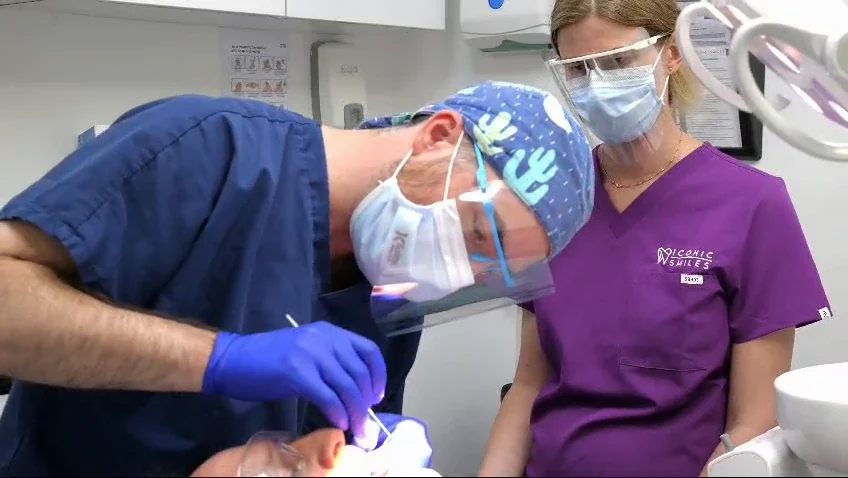
Many adults considering teeth straightening have dental work already: a crown placed years ago, a bridge, a missing tooth or perhaps an implant. That history does not automatically rule out orthodontic treatment. It does, however, make planning more individual. The aim may involve moving natural teeth while protecting existing restorations, then deciding whether anything else needs repair or replacement.
For a broader choice of appliances, see Invisalign versus fixed braces. If you are considering Invisalign treatment, ask for an assessment of the restorations and the bite before any simulation is treated as a final plan.
A related treatment-planning question is explored in Your Invisalign Journey: Assessment, Aligners, Refinements and Retention. This related guide addresses a different patient question and can help you compare your options without rushing a decision.
Start by identifying what can move
Natural teeth are supported by a periodontal ligament that allows controlled orthodontic movement. An osseointegrated dental implant does not have the same mechanism and is generally treated as a fixed position in orthodontic planning. A crown on a natural tooth moves with that tooth, provided the supporting structures are healthy enough.
These differences make the starting diagram important. A visible crown may look like a natural tooth, while its underlying support is quite different from an implant crown. Your clinician should identify which teeth can move, where root space is available and which restorations may limit a proposed change.
This is a reason for careful design, not necessarily for abandoning treatment.
Crowns on natural teeth
A crown may be placed over a root-treated or heavily restored tooth. Orthodontic movement may still be possible, but the clinician needs to assess its root, surrounding bone, gum health, restoration margins and any history of fracture or infection.
Attachments used with aligners may bond differently to ceramic or other restorative surfaces than to natural enamel. Fixed-brace brackets can present their own bonding and removal considerations. The treating team should discuss how these issues will be managed without unnecessarily damaging the crown.
If a crown is poorly shaped or its margin needs attention, it may make sense to repair or replace it before or after orthodontics depending on the situation. There is no single sequence for every patient.
Existing bridges can restrict movement
A bridge connects two or more teeth or implants through one restoration. That connection can restrict independent movement of supporting teeth. Attempting to move a tooth without considering the bridge risks creating a plan that cannot be executed as intended.
The clinician may discuss whether a bridge should remain unchanged, be replaced later or, in selected circumstances, be altered as part of a carefully coordinated plan. Decisions should account for tooth prognosis, the gap being restored and the health of the supporting teeth.
Ask what will happen if the bridge cannot be retained. A replacement is a significant cost and clinical intervention, so it should not appear unexpectedly late in treatment.
Implants: working around a fixed position
An implant crown can limit the movement of neighbouring teeth because the implant itself does not move orthodontically as a natural tooth does. The planned bite and the space around it may need to be designed with that fixed point in mind.
If you need both an implant and orthodontic treatment, the order can be crucial. In some cases orthodontics is carried out first to create appropriate tooth and root positions for later implant placement. In others, an existing implant must be accommodated throughout the plan.
The complete dental implant guide explains the wider implant pathway; this guide focuses on how it interacts with tooth movement.
Missing teeth and spaces can be opportunities or constraints
A missing tooth creates a space, but that does not mean the dentist can simply move any neighbouring tooth into it. Root positions, the bite, bone condition, smile appearance and long-term stability all need consideration.
A patient might reasonably choose to keep a space for a future replacement. Another may be suitable for orthodontic closure. The choice could change the need for surgery, the number of teeth requiring restoration and the overall duration.
You should be shown what each approach is intended to accomplish and which natural teeth would need moving. A visual setup can help, but final feasibility depends on clinical findings.
Gum health and previous root-canal treatment
Long-standing restorations often coexist with other dental issues. Gum disease needs assessment and appropriate management before active orthodontics. A root-treated tooth may be movable in some circumstances, but its prognosis and structural integrity require particular attention.
The dentist may need additional records or input from a restorative clinician, orthodontist or gum specialist. That coordination is a strength when cases are complex, not a sign that something is wrong with your mouth.
A clear plan should identify which findings could make treatment less predictable or lead to a different choice.
The value of treatment sequencing
A well-sequenced plan may involve stabilising gum health, restoring painful teeth, moving natural teeth, reviewing the new bite, then replacing missing teeth or renewing restorations. The sequence should minimise avoidable rework and help prevent irreversible decisions being taken too early.
Ask whether your proposed cosmetic work should be delayed until tooth positions are stable. Changing a crown's shape before orthodontics may sometimes create a restoration that no longer suits the final bite.
If two clinicians are involved, make sure responsibilities are clear. Who decides when orthodontics is complete and the restorative stage can begin? Who plans the retainer around existing bridgework?
Retention with crowns, bridges and implants
After orthodontic movement, natural teeth can move again. Retainers must be designed around the final arrangement, including crowns, implants and any planned restorative changes. A fixed retainer might not be appropriate across every type of restoration, and a removable retainer may need modification if future treatment changes tooth shape.
The British Orthodontic Society's retention advice provides useful background. Ask what happens if a crown needs replacement later and whether the retainer will still fit.
Retention should be part of the original treatment conversation, not an afterthought.
Questions to bring to your assessment
- Which teeth are natural, crowned, bridged or implant-supported?
- Which can move safely, and which are fixed reference points?
- Do existing restorations need attention before starting?
- Should missing spaces be closed or preserved for later replacement?
- Who coordinates orthodontic and restorative stages?
- Could later crowns or implants change the retainer design?
- What are the realistic alternatives if the preferred sequence is not suitable?
It is reasonable to ask the team to show you the proposed order of treatment in writing. Understanding the sequence helps you judge the time, cost and compromises involved.
References and further evidence
- NHS — Dental restorations, implants and orthodontics.
- European Federation of Periodontology — Implant basics and maintenance.
- British Orthodontic Society — Retainers.
Orthodontic movement around restorations or implants requires individual assessment, often with coordinated treatment planning. Do not assume an existing implant can be moved like a natural tooth.
Your next step, when you’re ready
We would be pleased to welcome you for a £30 consultation at your preferred Iconic Smiles practice. Bring your questions, and we can talk through the options that may suit you.
Any additional investigations and their fees will be explained before you decide.