
Composite Bonding for Cosmetic Reasons: Can You Improve Healthy Teeth?

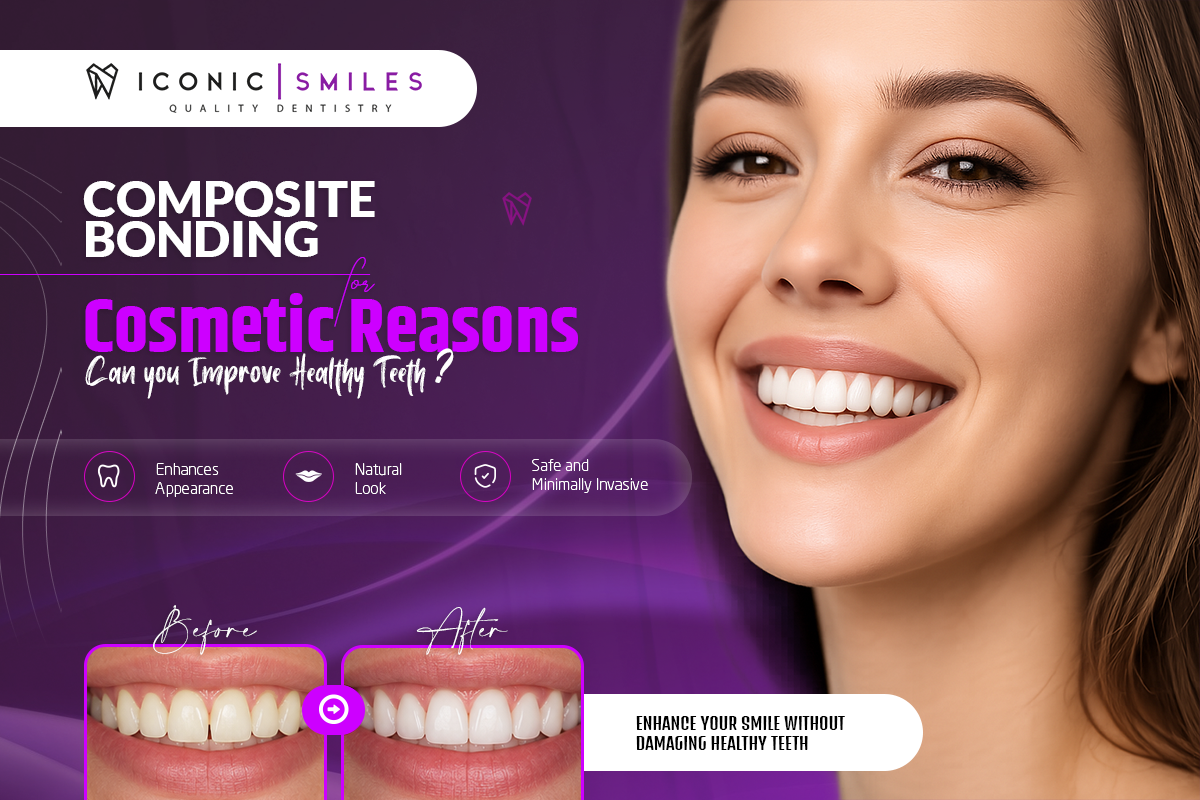
Yes. Composite bonding does not have to be used because there is something “wrong” with a tooth.
Many patients have completely healthy teeth but would simply like their smile to look more balanced, symmetrical or refined.
Composite bonding allows us to add carefully selected tooth-coloured resin to the surface or edges of teeth to change their shape, length, proportions and overall appearance. In suitable cases, this can be achieved with little or no removal of healthy enamel, making it one of the most conservative ways of cosmetically changing a smile.
At Iconic Smiles, the objective is not to create a row of identical, oversized white teeth.
Good cosmetic bonding should still look like your teeth — just better.
Why Have Composite Bonding if Your Teeth Are Healthy?
There are plenty of reasons someone may like their teeth medically, but not quite love their smile.
Cosmetic bonding can be considered if you would like to:
- make short teeth appear slightly longer
- improve uneven or irregular tooth edges
- make tooth shapes more symmetrical
- refine slightly narrow, small or misshapen teeth
- soften sharp corners
- improve the proportions of your smile
- close selected small spaces
- restore symmetry after orthodontic treatment
- disguise selected surface imperfections
- improve worn-looking front edges
- create a more balanced smile line
Sometimes the change required is only a fraction of a millimetre.
That is often where composite bonding works best.
Rather than dramatically changing every tooth, carefully placed composite can make subtle alterations that change the way the entire smile looks.
What Does Cosmetic Composite Bonding Actually Change?
A cosmetic smile is not simply about making teeth whiter.
We look at:
Shape.
Are some teeth too square, too rounded, too narrow or disproportionately small?
Length.
Do the front teeth have the right relationship to each other and to the smile line?
Symmetry.
Are corresponding teeth balanced without looking unnaturally identical?
Edges.
Are there small irregularities, wear or asymmetries that interrupt the smile?
Proportions.
Would adding composite improve the tooth — or simply make it look too wide or bulky?
Colour.
Would whitening alone achieve what the patient wants before we consider adding anything to the teeth?
The bite.
Can the proposed new tooth shape function safely when you bite and move your jaw?
This is why two patients asking for “six teeth of composite bonding” may need completely different treatment plans.
The Most Important Question: Should We Bond the Teeth at All?
This is the bit that tends to get missed with cosmetic bonding.
Being able to put composite on a tooth does not mean that we should.
Sometimes whitening is all that is required.
Sometimes a tiny amount of edge bonding is enough.
Sometimes the teeth are simply in the wrong position and orthodontic treatment will produce a better result while requiring considerably less composite afterwards.
Sometimes an align, bleach, bond approach gives the best balance between tooth position, colour and shape.
And sometimes the teeth already look great and our advice is genuinely to leave them alone.
That assessment matters.
Our philosophy at Iconic Smiles is to make the smallest intervention that produces the right result, rather than automatically bonding more teeth because more treatment is possible.
Natural Composite Bonding vs the “Composite Veneer” Look
There is an enormous difference between simply covering teeth in composite and properly designing a smile.
Natural teeth are not flat white blocks.
They have line angles, surface texture, translucency, variation in shape and subtle differences in the way light reflects from them.
High-quality anterior composite therefore involves considerably more than choosing a white shade and adding resin.
Direct anterior composite is recognised as a technique-sensitive treatment requiring both technical and artistic skill from the clinician.
The aim should be for somebody to notice your smile, rather than immediately notice your bonding.
How We Plan Cosmetic Composite Bonding
-
Understand what you actually want to change
We first establish what bothers you about your smile.
Sometimes the issue a patient thinks is colour is actually tooth position. What appears to be uneven tooth length may be an asymmetry in the gum line or bite.
Good treatment starts with diagnosis rather than resin.
-
Assess the teeth, gums and bite
Before purely cosmetic treatment, the teeth and gums should be healthy.
We also assess how the teeth contact during biting and jaw movements because beautiful composite that repeatedly fractures is not a good cosmetic result.
-
Plan shape and proportions
Photography, digital scans, smile design or mock-ups may be used where appropriate.
The question is not simply, “Can we make this tooth bigger?”
It is:
How much should we change it before it stops looking like a natural tooth?
-
Consider whitening or alignment first
Composite does not whiten afterwards in the same way as natural enamel.
If you want your teeth significantly lighter, whitening is therefore usually considered before choosing the final composite shade.
Likewise, moving a badly positioned tooth before bonding can substantially reduce the amount of restorative material required.
-
Sculpt the composite
The tooth surface is carefully conditioned and adhesive applied.
Composite is then placed and shaped by hand to create the planned contours, length and proportions.
-
Finish and polish
The final stages are extremely important.
Line angles, edges, embrasures, texture and surface polish affect how the tooth reflects light and ultimately whether the restoration looks artificial or natural.
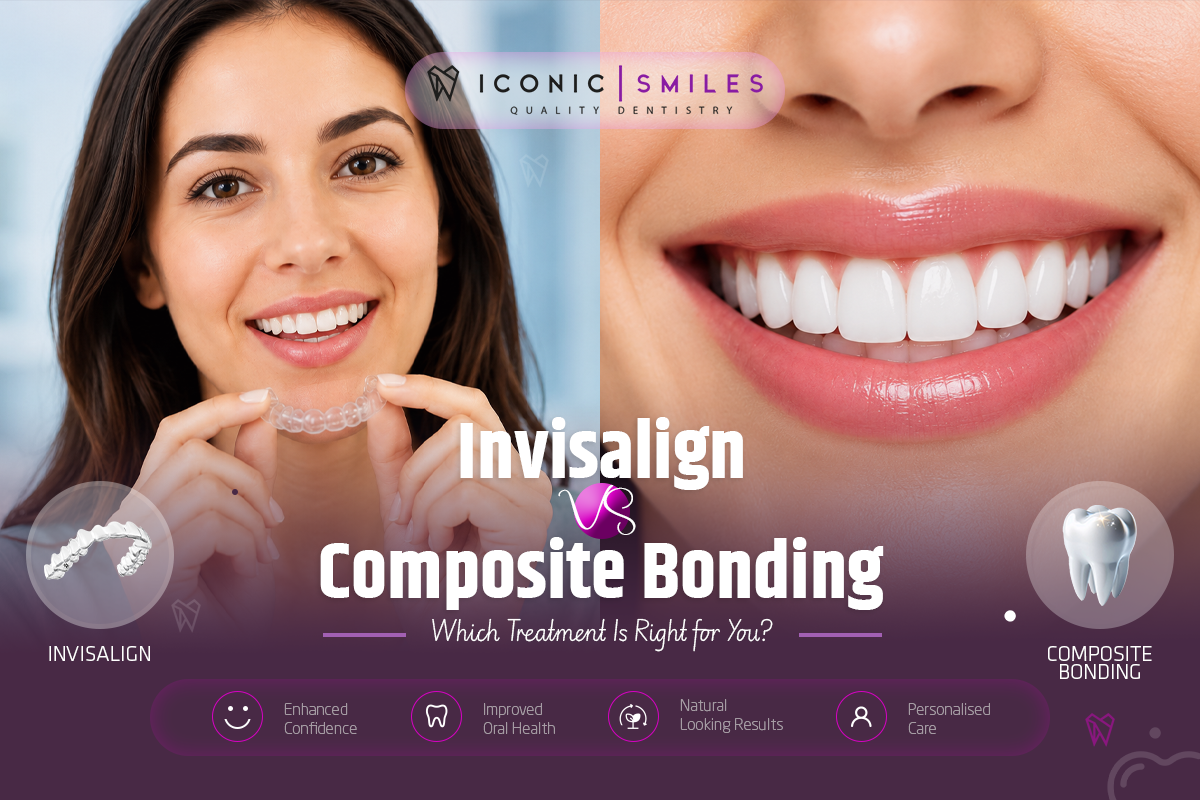
Should I Have Bonding or Invisalign?
They solve different problems.
Invisalign or other orthodontic treatment moves teeth.
Composite bonding changes the shape of teeth.
If your teeth are well positioned but their shape or proportions bother you, bonding alone may be appropriate.
If the main issue is tooth position, crowding or rotation, simply adding composite can sometimes camouflage the problem but result in unnecessarily bulky teeth.
For some patients, the most conservative cosmetic solution is therefore:
Align → Bleach → Bond
Straighten the teeth first.
Whiten them to the desired shade.
Then use the smallest amount of composite necessary to refine shape and symmetry.
Iconic Smiles already uses this combined approach in appropriate cosmetic cases.
How Many Teeth Need Composite Bonding?
There is no correct number.
Some patients need one small edge repaired.
Others may benefit from treating four, six or more teeth to produce appropriate symmetry across the smile.
We do not believe treatment should be sold by tooth count before the smile has been assessed.
The number depends on which teeth are visible when you smile, their existing proportions, symmetry and what you are actually trying to achieve.
Sometimes doing fewer teeth produces the better result.
Is Cosmetic Bonding Reversible?
Composite bonding is commonly described as reversible, but that needs some qualification.
Where treatment is entirely additive and no healthy tooth structure has been removed, it can be extremely conservative.
However, once a tooth has been etched and bonded, removing composite later must still be performed carefully to minimise alteration to the underlying enamel.
It is therefore better to think of composite as highly conservative, rather than treating it as something completely consequence-free.
How Long Does Cosmetic Composite Bonding Last?
There is no fixed expiry date.
Anterior composite restorations can perform successfully for many years, but published studies show considerable variation according to the type of restoration, case selection, operator and clinical circumstances.
Longevity can be influenced by:
- the amount and position of composite
- the patient’s bite
- grinding and clenching
- biting habits
- staining
- oral hygiene
- maintenance
Composite may eventually require polishing, repair or replacement.
One significant advantage is that localised composite damage can often be repaired rather than requiring the entire restoration to be replaced.
Why Choose Dr Vishal Patel for Cosmetic Composite Bonding?
With cosmetic bonding, the material itself is only part of the equation.
The person shaping it matters enormously.
Dr Vishal Patel qualified in 2011 and has spent much of his career providing restorative and cosmetic dentistry, including composite bonding, veneers, crowns, orthodontic treatment and complete smile makeovers. He has undertaken further training including Mini Smile Makeover, Invisalign, Six-Month Smiles and Fastbraces, and incorporates digital scanning and modern smile-planning technology into his treatment.
But the reason we particularly recommend Vish for cosmetic bonding is simpler:
he understands when to stop.
The hardest cosmetic dentistry is rarely making the biggest change.
It is knowing which 0.5 mm matters, which tooth needs altering, which tooth should be left completely alone and how to create symmetry without making a smile look manufactured.
His approach combines the restorative side of dentistry with orthodontics and smile design. That means he is not restricted to seeing every cosmetic problem as a bonding problem.
If a tooth would look better moved first, he can identify that.
If whitening alone will achieve what you want, he can tell you.
If align-bleach-bond will preserve more natural tooth structure, that can be planned from the outset.
And if composite is the right treatment, every tooth is individually shaped rather than simply being made larger and whiter.
That judgement is what separates excellent cosmetic bonding from simply putting composite onto teeth.
Why Iconic Smiles?
Iconic Smiles provides composite bonding and cosmetic smile treatment across Hertfordshire and North London.
Our cosmetic pathway combines clinical assessment, photography, digital scanning and smile planning, with input from orthodontic, restorative and other clinicians where a case requires it.
Composite bonding currently starts from £325 per tooth, although the final fee depends on the number of teeth and complexity of treatment.
Most importantly, we do not start with the question:
“How many teeth would you like bonded?”
We start with:
“What would you like to improve, and what is the most conservative way of achieving it?”
If that answer is composite bonding, we can design it.
If there is a better option, we will tell you that too.
Considering Composite Bonding for Cosmetic Reasons?
If your teeth are healthy but there are things you would like to change about their shape, proportions, symmetry or overall appearance, book a cosmetic consultation with Dr Vishal Patel and the Iconic Smiles team.
We can assess your smile, explain what composite bonding could realistically change and advise whether bonding alone — or a combination of whitening, alignment and bonding — would produce the most natural and conservative result.
Don’t just change your smile. Make it iconic.