
Invisalign vs Composite Bonding: Which Treatment Is Right for You?

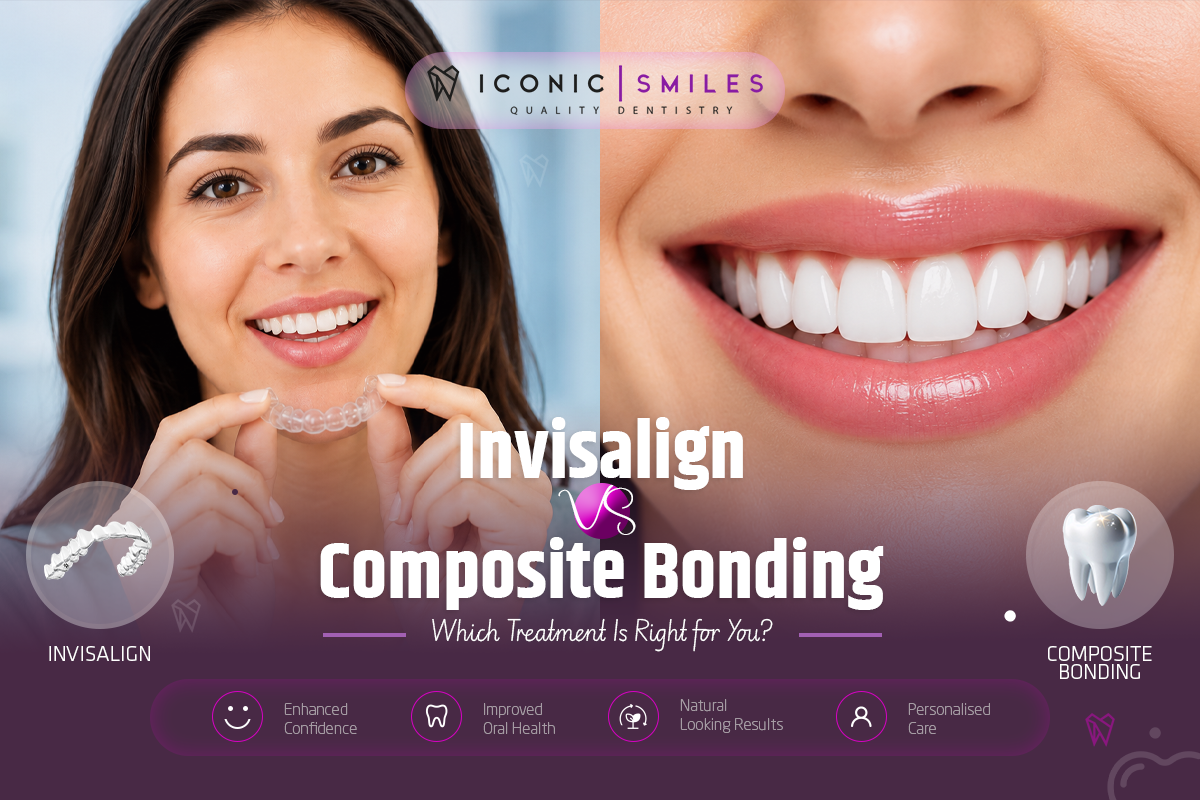
If you’re considering improving your smile, you may be wondering whether Invisalign or composite bonding is the right treatment for you. While both are popular cosmetic dental procedures, they address very different concerns.
The main difference is straightforward: Invisalign straightens teeth by moving them into their ideal position, whereas composite bonding enhances the appearance of teeth by repairing or reshaping them. One treats alignment, while the other focuses on aesthetics.
Choosing the right option depends on your individual smile, treatment goals and budget. In some cases, combining both treatments provides the best possible result.
This guide explains the differences between Invisalign and composite bonding, helping you make an informed decision about which treatment is right for you.
What Is Invisalign and How Does It Work?
Invisalign is a modern orthodontic treatment that uses a series of custom-made, clear plastic aligners to gradually move teeth into better alignment.
Each aligner is individually designed to fit your teeth and applies gentle, controlled pressure to guide them into their planned position. You’ll usually wear each set of aligners for one to two weeks before moving on to the next set.
Unlike fixed braces, Invisalign aligners are removable, allowing you to eat, drink, brush and floss normally. To achieve the best results, they should be worn for 20 to 22 hours a day.
Treatment typically takes 6 to 18 months, depending on the complexity of your case.
Invisalign may be suitable if you have:
- Crowded or overlapping teeth
- Gaps between teeth
- Rotated teeth
- Mild to moderate overbites, underbites, crossbites or open bites
- Teeth that are misaligned with your facial midline
If your teeth are healthy but not in the correct position, Invisalign is often the most effective treatment because it corrects the underlying alignment rather than simply masking the problem.
What Is Composite Bonding and How Does It Work?
Composite bonding is a cosmetic dental treatment that improves the appearance of teeth using a tooth-coloured composite resin.
The resin is carefully applied to the tooth surface, sculpted to the desired shape, hardened using a special curing light and polished to create a natural-looking finish.
Unlike Invisalign, composite bonding does not move teeth. Instead, it changes their shape, size or appearance, making it ideal for correcting cosmetic imperfections.
Treatment is usually completed in a single appointment, typically taking 1 to 3 hours, depending on the number of teeth being treated. In most cases, very little or no drilling is required, and local anesthetic is often unnecessary.
Types of composite bonding
Composite veneers involve covering the front surface of the tooth with composite resin to improve its shape, size and overall appearance.
Edge bonding focuses on repairing worn edges, chipped corners and minor irregularities along the biting edge of the teeth.
Composite bonding may be suitable if you have:
- Chipped or cracked teeth
- Worn tooth edges
- Teeth that appear uneven or too short
- Small gaps between teeth
- Minor surface defects
- Misshapen teeth that don’t require orthodontic treatment
Composite bonding is considered a minimally invasive cosmetic treatment because it usually adds material to the tooth rather than removing healthy enamel.
Invisalign vs Composite Bonding: Key Differences
| Feature | Composite Bonding | Invisalign |
| Treatment type | Cosmetic restorative treatment | Orthodontic treatment |
| Purpose | Improves the shape, size and appearance of teeth | Straightens teeth by moving them into better alignment |
| Best for | Chipped teeth, worn edges, uneven shapes, cosmetic imperfections and small gaps | Crowded teeth, gaps, rotated teeth and mild to moderate bite problems |
| How it works | Composite resin is applied, sculpted and polished directly onto the tooth | A series of clear aligners gradually move teeth into position |
| Treatment time | Usually one appointment (1–3 hours) | Typically 6–18 months |
| Results | Immediate | Gradual throughout treatment |
| Tooth preparation | Usually minimal or none | None |
| Longevity | Typically 4–8 years before repairs or replacement may be required | Long-lasting with regular retainer wear |
| Maintenance | Good oral hygiene, polishing and occasional repairs | Wearing retainers after treatment to maintain results |
| Cost | Usually lower | Usually higher |
| NHS availability | Cosmetic treatment is generally not available on the NHS | Usually available privately for cosmetic treatment |
Invisalign vs Composite Bonding: Which Treatment Do You Need?
The right treatment depends on the nature of your dental concerns.
If the problem is the position of your teeth, Invisalign is usually the better option. It can straighten crooked teeth, correct crowding, close gaps and improve many mild to moderate bite issues.
If the problem is the shape or appearance of your teeth, composite bonding is often the preferred treatment. It can repair chips, restore worn edges, reshape uneven teeth and improve minor cosmetic imperfections in just one visit.
A consultation with an experienced cosmetic dentist will determine which treatment is most suitable for your smile.
Can You Have Invisalign and Composite Bonding Together?
Yes. In many cases, combining Invisalign with composite bonding provides the most natural and aesthetically pleasing result.
A common treatment plan is to complete Invisalign first, allowing the teeth to move into their ideal positions. Once the alignment has been corrected, composite bonding can be used to refine the shape, repair chips and improve the overall appearance of the smile.
For example, if you have slightly crowded teeth alongside chipped front teeth, your treatment may involve:
- Invisalign to straighten the teeth and improve the bite.
- Composite bonding to repair chips, close any remaining small spaces and perfect the final smile.
By aligning the teeth first, less composite material is often required, resulting in a more conservative and natural-looking outcome.
When Neither Treatment Is the Right Choice
Neither Invisalign nor composite bonding should be carried out until any underlying dental problems have been treated.
Your dentist may recommend addressing these issues first if you have:
- Active tooth decay
- Untreated gum disease
- Teeth weakened by extensive damage
- Large existing fillings or fractured teeth
- Significant internal tooth discolouration that may be better treated with alternative cosmetic procedures
A comprehensive examination ensures that any cosmetic treatment is carried out on healthy teeth and gums.
Frequently Asked Questions
Is Invisalign better than composite bonding?
Neither treatment is better than the other—they simply solve different problems. Invisalign improves tooth alignment, while composite bonding improves the appearance of individual teeth.
Is composite bonding cheaper than Invisalign?
Generally, yes. Composite bonding usually costs less because treatment is completed in a single appointment. Invisalign requires custom-made aligners, regular review appointments and several months of treatment.
Can composite bonding straighten crooked teeth?
Composite bonding can improve the appearance of slightly uneven teeth, but it cannot physically move them. If your teeth are crowded or misaligned, orthodontic treatment such as Invisalign is usually the better option.
How long does composite bonding last?
Composite bonding typically lasts 4 to 8 years, although this varies depending on oral hygiene, diet, bite forces and lifestyle habits. Repairs or replacement may be needed over time.
Are Invisalign results permanent?
The tooth movement achieved with Invisalign can last for many years, provided you wear your retainers as instructed. Without retainers, teeth naturally tend to drift over time.
Why Choose Iconic Smiles?
Successful cosmetic dentistry starts with an accurate diagnosis, not simply choosing the latest treatment.
At Iconic Smiles, we assess your teeth, bite, gums and overall oral health before recommending the most appropriate solution. Whether you would benefit from Invisalign, composite bonding or a combination of both, we’ll explain your options clearly and provide honest, personalised advice based on your individual needs.
As a multi-award-winning NHS and private dental group serving Hertfordshire and North London, we provide a full range of cosmetic and restorative treatments, including Invisalign, composite bonding, dental implants, braces and complete smile makeovers.
Whether you’re looking to straighten your teeth, repair cosmetic imperfections or transform your smile, our experienced team is here to help.
Book your consultation today and discover the treatment that’s right for you.