


Can Composite Bonding Fix a Chipped Tooth?

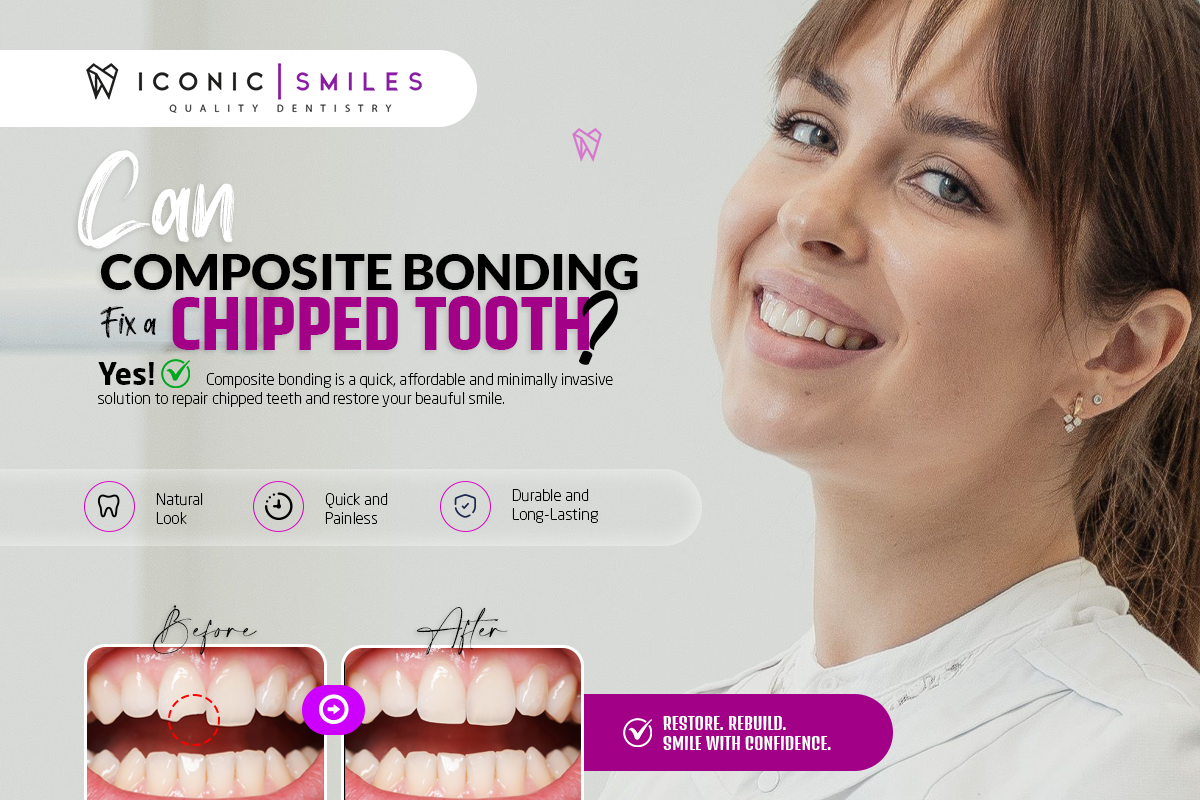
Yes. Composite bonding is often an excellent conservative treatment for a small or moderate chip, particularly in a front tooth. Tooth-coloured composite resin is bonded to the remaining tooth and carefully sculpted to restore its shape.
However, not every chipped or fractured tooth should simply be bonded. The appropriate treatment depends on how much tooth structure has been lost, whether dentine or the pulp is involved, the condition of the remaining tooth and the forces placed on it when you bite.
A small enamel chip may be mainly cosmetic, whereas a deeper fracture can cause sensitivity, pain or require more extensive treatment. The tooth therefore needs to be properly assessed first.
What Is a Chipped Tooth?
A chipped tooth occurs when part of the tooth structure breaks away. A small chip may affect enamel alone, while a deeper fracture can extend into dentine and, in more significant injuries, towards or into the pulp at the centre of the tooth.
Tooth enamel is a tough outer protective layer, but it is not indestructible.
Small enamel chips may cause little or no discomfort. Where dentine is exposed, patients can experience sensitivity to cold, heat or pressure. More extensive fractures involving the pulp may cause significant symptoms and require different treatment.
What Causes Chipped Teeth and Worn Edges?
Chipped teeth and worn edges can occur for several reasons, including:
- Biting unexpectedly onto something hard, such as a stone in food, boiled sweets or ice.
- Nail-biting and chewing on pens.
- Large or ageing restorations that have reduced the amount of remaining natural tooth structure.
- Dental decay that has weakened the tooth.
- Acid erosion or tooth wear that has thinned the enamel.
- Trauma such as a fall, sporting injury or accident.
- Grinding, clenching or other heavy biting forces that repeatedly load the teeth.
Front teeth are commonly affected following trauma, while back teeth can also chip or fracture under heavy biting forces or around existing restorations.
The absence of pain does not necessarily tell us how deep a fracture is, so the tooth should be assessed where there is any doubt.
How Do You Know If Your Tooth Is Chipped?
Sometimes a chip is immediately obvious. You may see that part of the tooth is missing or notice a new rough or sharp edge with your tongue.
Other symptoms do not diagnose a chipped tooth by themselves.
Pain when biting, sensitivity to hot or cold, intermittent toothache, spontaneous pain or swelling can occur with deeper fractures, cracked teeth, decay, pulpal disease or infection. A dentist needs to examine the tooth to determine the actual cause.
You should arrange prompt assessment if the tooth has been significantly traumatised, a large piece has broken away, the tooth is mobile, or you develop marked sensitivity, pain or swelling.
A chipped tooth cannot be rebuilt permanently at home. If you still have a fragment of tooth following an injury, keep it safe and bring it with you because reattachment may sometimes be possible.
How Composite Bonding Repairs a Chipped Tooth
Dentists use tooth-coloured composite resin to rebuild the missing portion of the tooth.
The resin is applied directly to the affected tooth and shaped by hand until it recreates the required contour and blends naturally with the surrounding tooth structure.
One of the main advantages of direct composite is that selected chips can often be repaired while preserving almost all of the remaining healthy tooth.
Composite is used extensively in both front and back teeth. Whether it is appropriate for a particular fracture depends on the extent of the damage, remaining tooth structure, bite, isolation, grinding or clenching habits and the functional demands placed on the restoration.
Bonding a chipped tooth can offer several advantages:
It can provide an immediate restoration in many suitable cases.
- Healthy tooth structure can often be preserved.
- Patients can usually return to normal function once treatment is complete.
- Normal brushing and interdental cleaning can be continued.
- Composite can usually be repaired or modified relatively conservatively if it chips or wears in the future.
Composite restores missing tooth structure, but it does not guarantee that future pulpal disease, decay or infection cannot occur. If the pulp is already significantly damaged or infected, other treatment may be required.
What Other Treatments Can Be Used for a Chipped Tooth?
Treatment depends on the depth and extent of the fracture rather than simply the fact that a tooth has chipped.
Depending on the circumstances, treatment may include:
- smoothing or polishing a very small enamel chip
- reattaching the original tooth fragment where appropriate
- direct composite restoration
- a veneer or crown in selected larger structural defects
- root canal treatment where the pulp has been irreversibly damaged or infected
- other restorative treatment where insufficient healthy tooth remains for straightforward bonding
The important part is establishing the diagnosis before deciding how the tooth should be restored.
The Step-by-Step Chipped Tooth Repair Process
Step 1: Consultation and Shade Matching
The dentist examines the tooth closely and assesses the extent of the fracture, remaining tooth structure, bite and symptoms. Additional tests or radiographs may be required depending on the circumstances.
A composite shade is then selected to match the natural colour of the tooth.
Good shade matching helps the finished restoration blend naturally with the surrounding enamel.
Step 2: Enamel Conditioning and Bonding
Where appropriate, the tooth surface is carefully conditioned and an adhesive system is applied to create a secure bond between the composite and the tooth.
For a small additive repair, little or no removal of healthy tooth structure may be required and many patients do not require local anaesthetic. More extensive fractures can require a different approach.
Step 3: Layering and Sculpting
Dentists apply resin in thin layers.
Each layer is built and shaped by hand to recreate the contour, translucency, surface texture and edge characteristics of the natural tooth.
Anterior composite bonding is technically demanding. The quality of the final result depends heavily on case selection and the clinician’s ability to reproduce natural tooth shape, texture, shade and light reflection.
Step 4: Curing and High-Shine Polishing
A curing light is used to harden the composite.
Afterwards, the restoration is refined and polished so that its shape, surface texture and sheen blend as naturally as possible with the surrounding enamel.
A straightforward single-tooth repair can often be completed in one appointment, although treatment time varies according to the complexity of the fracture and the result required.
How Long Does Composite Bonding Last on a Chipped Tooth?
Composite bonding can last for many years, but its lifespan varies considerably between patients and restorations.
Longevity depends on the size and position of the restoration, how much natural tooth remains, the bite, grinding or clenching, diet, oral hygiene and maintenance.
- To help protect bonded teeth:
- Avoid biting ice, pens, fingernails and other very hard objects.
- Maintain good brushing and interdental cleaning.
- Attend regular dental examinations and hygiene appointments.
- If you clench or grind your teeth, your dentist may recommend an occlusal splint where appropriate.
- Remember that composite can often be polished or repaired if it stains, wears or chips rather than automatically needing complete replacement.
Why Choose Iconic Smiles for Chipped Tooth Repair?
The first question we ask is not simply “can we bond this tooth?” but “why did it chip, how much tooth has been lost and what is the most appropriate way to restore it?”
A tiny enamel chip, a fractured tooth around an old filling and a traumatised front tooth with pulpal involvement are three very different clinical situations and should not be treated as though they are the same thing.
Our dentists perform careful and considered bonding work with particular attention to tooth shape, contour, texture, shade and the way the repaired tooth functions within your bite.
More importantly, we offer an honest opinion on whether bonding or an alternative treatment is more appropriate for you.
If you have chipped or fractured a tooth, book an assessment with Iconic Smiles and we can determine the cause, the extent of the damage and the most conservative appropriate treatment.